Why Remote Sensing Matters for Data Center Power Panels
Voltage drop across long cable runs costs data centers energy, uptime, and money. Remote sensing in power supplies closes the feedback loop at the load, delivering precise voltage where it counts.
By: Ron Stull, Content Manager at Bel Fuse Inc
The Hidden Cost of Voltage Drop
Data center power infrastructure is growing more complex every year. Higher rack densities, longer cable runs between power distribution units (PDUs) and server racks, and the constant push for greater efficiency all put pressure on one fundamental requirement: delivering stable, accurate voltage to every load.
The problem is straightforward. Every meter of cable, every connector transition, and every printed circuit board (PCB) trace between a power supply and its load introduces resistance. That resistance causes voltage drop. In low-voltage, high-current systems, which are increasingly common in modern data centers, even a small drop can push sensitive equipment outside its operating specification. The voltage at the power supply output is not the voltage the server, switch, or storage system actually receives.
The traditional workaround is to manually increase the power supply output to compensate for expected losses. This approach is simple to deploy, but it introduces real risks. It cannot adapt to changing load conditions, temperature shifts, or changes in cable routing. If the load decreases, the excess voltage can overstress downstream components. If the load increases beyond what was calibrated for, voltage still sags.
Remote sensing offers a better solution.
How Remote Sensing Works
Remote sensing is a feedback technique built into many modern power supplies. Instead of regulating voltage only at the supply’s output terminals, the power supply monitors voltage directly at the load using a dedicated pair of sense lines. These sense lines (typically a twisted differential pair) carry negligible current and are not subject to the same voltage drop that affects the main power conductors.
The principle is similar to a four-wire Kelvin connection used in precision measurement. The supply compares the voltage it reads at the load against the intended setpoint. If there is a difference (caused by cable resistance, connector losses, or trace impedance), the supply adjusts its output upward until the load receives exactly the target voltage.
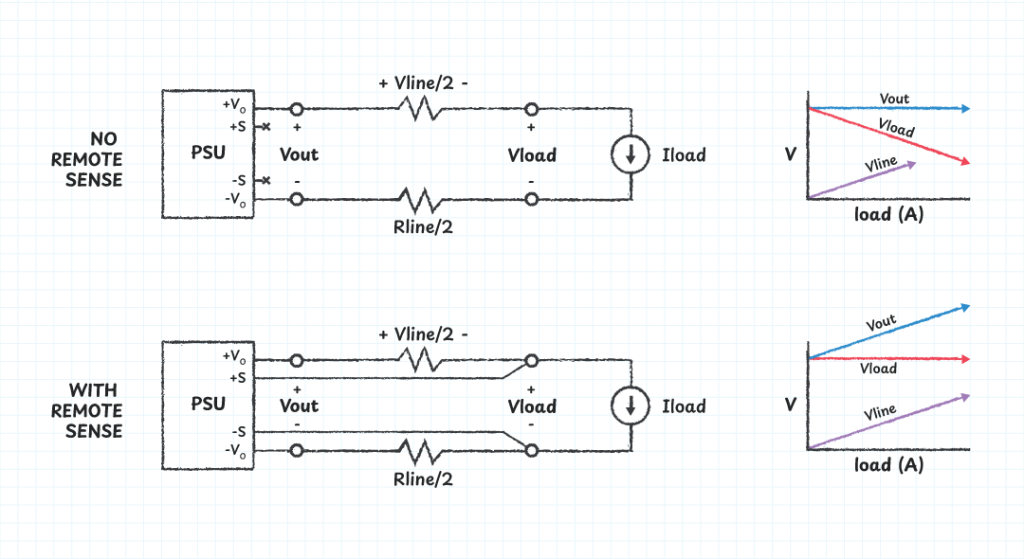
This compensation happens automatically and in real time. As load conditions change (servers spinning up, workloads shifting between racks, cooling fans cycling), the power supply continuously adjusts. There is no need for manual recalibration when cables are rerouted, connectors are replaced, or panel layouts are modified.
Why Data Center Panels Benefit Most
Data centers present exactly the conditions where remote sensing delivers the greatest impact.
Energy Efficiency at Scale
When voltage drops across power distribution cables, constant-power loads (such as server processors and storage drives) compensate by drawing more current. This increased current generates additional heat (following P = I²R), which wastes energy and increases cooling demand. Across thousands of nodes in a large facility, even a 1% ~ 2% improvement in power delivery efficiency translates to meaningful reductions in electricity costs and thermal management overhead.
By maintaining accurate voltage at each load, remote sensing minimizes excess current draw throughout the distribution network, supporting the efficiency targets that 80 PLUS Titanium-rated and similar high-efficiency power supplies are designed to achieve.
Reliability and Uptime
Voltage instability is a common but often overlooked contributor to component degradation and unexpected failures. When equipment operates outside its specified voltage range, even slightly, it accelerates wear on capacitors, voltage regulators, and other sensitive components. Remote sensing ensures that every load in the panel receives voltage within specification, reducing thermal stress and extending equipment life. For data center operators, this directly supports uptime targets and reduces unplanned maintenance.
Adaptability to Changing Configurations
Data center panels are not static. Racks are added, cable paths change, and power distribution is reconfigured as capacity demands evolve. With manual voltage compensation, each change requires re-evaluation and adjustment. Remote sensing eliminates this maintenance burden. The feedback loop adapts automatically, whether the change involves a new cable run, a different connector type, or a complete panel reconfiguration.
Practical Considerations for Panel Builders
To achieve these benefits in practice, panel builders should consider several design details.
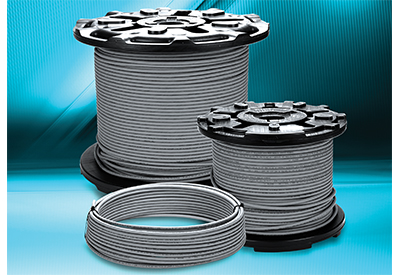
Use twisted sense wire pairs. A twisted differential pair cancels common-mode noise and maintains signal integrity, which is essential in electrically noisy data center environments with high-frequency switching equipment nearby.
Select quality connectors. Poor connections at the sense line terminals introduce unpredictable resistance, undermining the accuracy that remote sensing is designed to provide.
Route sense lines away from high-current paths. Treat sense wires as sensitive signal conductors. Keep them separated from power rails and switching nodes to minimize Electromagnetic Interference (EMI) pickup.
Evaluate whether sensing is necessary. For very short, low-resistance connections where voltage drop is negligible (typically under a few millivolts), remote sensing may add unnecessary complexity. A useful threshold is when the drop exceeds 1% ~ 2% of the target voltage.
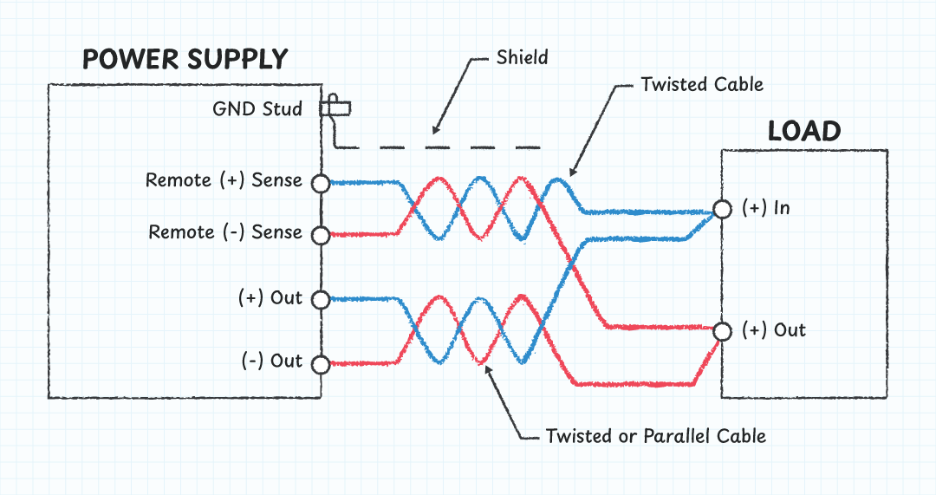
Shielded twisted cable carries the Remote (+) and Remote (-) sense lines, with the shield terminated to the GND stud.
Closing the Loop on Power Delivery
As data center power demands continue to grow, driven by higher rack densities, artificial intelligence workloads, and expanding infrastructure, the gap between power supply output and actual load voltage becomes increasingly consequential. Remote sensing closes that gap by providing real-time, automatic voltage compensation at the point of use.
For panel builders and engineers designing and maintaining data center power distribution systems, remote sensing has evolved from a specialized feature into a foundational requirement for efficient, reliable power delivery.
More information from Bel Fuse
About the Author
Ron Stull is the content manager and electrical engineer at Bel Fuse Inc, a leading global manufacturer of products that power, protect, and connect electronic circuits.