

Quantum Sensing: The Next Leap for IoT
September 9, 2026
By Filippo Di Giovanni
Quantum-mechanical concepts have proved fundamental to emerging breakthrough technologies such as quantum computing (QC). Now, the same principles are driving a new branch in sensing technology. Quantum sensors (QSs) exploit direct quantum phenomena to measure physical quantities with unmatched level of precision.
Unlike quantum-inspired algorithms, which run on conventional hardware and borrow quantum concepts as computational heuristics, QSs rely on physical quantum states. This makes them uniquely valuable for IoT systems deployed in environments where conventional sensing technologies hit a wall of accuracy limitations.
How quantum science powers IoT
Intelligent IoT devices and AI-powered autonomous systems need highly accurate measurements of physical quantities such as magnetic and gravitational fields, time intervals, rotation and acceleration, at sensitivities that prove challenging for conventional sensors. This is why QSs have entered the IoT arena.
QSs exploit phenomena involving microscopic objects such as atoms, ions, electrons, and photons, whose behavior is governed by quantum properties: superposition, coherence, and entanglement—concepts once buried in textbooks but now sufficiently popularized thanks to quantum computing (QC).
The counterintuitive principles of quantum mechanics
Superposition causes a quantum system to exist as a combination of different states simultaneously—each one associated to a probability amplitude—until a measurement makes it “collapse” into a single state, with the likelihood of each outcome expressed by the squared magnitude of this amplitude.
Coherence preserves the phase relationship between the components of a quantum superposition: if the phase relationship is maintained, constructive interference occurs and the quantum contributions reinforce one another, making that outcome more likely. Conversely, if the phase relationship is destructive, the outcome becomes impossible.
Entanglement, famously defined “spooky action at a distance”, creates strong correlations between two quantum systems, which persist even when they are spatially separated. Depending on how a quantum state responds to its environment, QSs are capable of detecting extremely minute changes in physical quantities.
Integrating such sensors across IoT architectures could extend the scope of distributed sensing into areas where conventional sensing is constrained by practical limits.
A typical example of QS
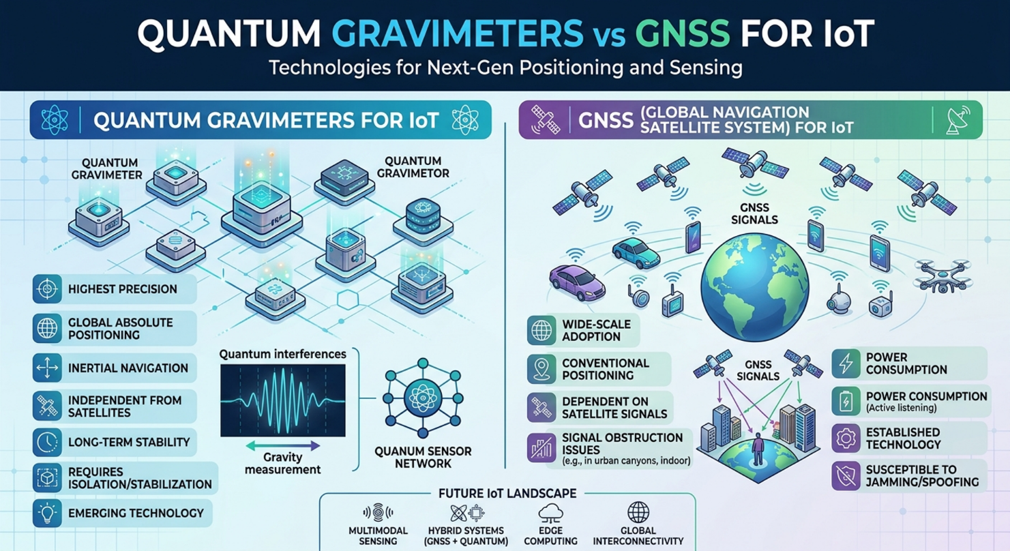
The Global Navigation Satellite System (GNSS) is essential for maritime and aviation navigation—beyond driving us to the nearest café—providing accurate coordinates for location, speed, and time. However, because GNSS operates with weak satellite signals propagating through the atmosphere, it is susceptible to jamming (blocking signals) and spoofing (broadcasting fake signals to corrupt location data).
A practical example of QS is provided by quantum gravimeters, which use atom interferometry to measure extremely small variations in Earth’s gravitational field. These instruments exploit the wavelike behavior of atomic particles 1 and operate without satellite signals, making them immune to traditional jamming and spoofing.
Operation of a quantum gravimeter
A quantum gravimeter measures the local gravitational field by exploiting atom interferometry, in which the phase of ultracold atoms is extremely sensitive to gravitational acceleration.
A gravimeter essentially operates by releasing a cloud of chilled atoms, such as rubidium-87 or cesium-133, cooled to near absolute zero, in a vacuum chamber. Precisely timed laser pulses are then shone on the falling atoms with the purpose of splitting their quantum wave function into two separate paths, comparable, in principle, to the effect of a beam splitter in an optical interferometer. As the atoms fall, local gravity induces a phase shift between the two atomic wave packets. When the paths are recombined, the resulting interference pattern allows the local gravitational acceleration to be measured with very high precision.
Because the Earth’s gravitational field subtly changes depending on the geology underneath its surface, these readings create a very specific “gravity map.” Gravitational acceleration g at Earth’s surface is, as we all know, about 9.81 m/s², whereas local variations can reach roughly 10-6 to 10-7 m/s², depending on the location.
By matching real-time gravimeter measurements with data of an existing map, an onboard navigation system can estimate its position and periodically correct the drift of an Inertial Navigation Systems (INS), which continuously tracks space coordinates, velocity, and orientation using accelerometers and gyroscopes—all without a single GNSS signal.
Vessel equipped with a quantum gravimeter
Recent field trials demonstrated this capability aboard a 29-meter surface vessel sailing across the Australian Coral Sea where position error stayed within one nautical mile over an 83-km route, while achieving unjammable, GNSS-free positioning. These features can strengthen the IoT applications in autonomous driving, navigation, geophysical monitoring, and other fields where the target requirements cannot be met by the conventional positioning or sensing techniques.
Will future IoT rely more on quantum phenomena?
IoT is growing at a sustained pace, permeating virtually every aspect of human activity, from factory automation and smart homes to personal devices such as fitness trackers and smart watches. Still, critical applications demand precise sensing and efficient resource management, while accommodating the low latency enabled by edge computing and the large-scale computing and storage capabilities deployed in the cloud. The advent of algorithms driven by quantum principles could mitigate the complexity of task coordination inherent in these systems.
From the sensing perspective, quantum sensors are ushering in a new generation of devices capable of highly accurate measurements of physical parameters, potentially increasing the security and reliability of critical systems such as autonomous vehicles.
The “VEGA” project (Vehicle-based Exploration of Gravity using Atoms), aims to develop and prototype embedded cold-atom gravimeters in a strap-down configuration, without active stabilization platform. However, significant engineering challenges need to address hybridization and integration of quantum sensors with conventional sensors, as stand-alone quantum detectors still face difficulties in meeting the constraints imposed by dynamic environments 2.
While this article has focused on quantum sensing and the previous one on quantum-inspired algorithms, these technologies represent only part of the broader vision of the Quantum Internet of Things (QIoT), which also encompasses areas such as quantum computing, quantum communications, and quantum cybersecurity.
References
1 According to French physicist De Broglie, a particle with momentum is associated with a wave of wavelength
, where
is Planck’s constant