Automotive Panel Market Thrives Despite Tariff Uncertainty
While U.S. tariffs have increased costs, demand for automotive control systems continues to increase
By: Barbara Jorgensen, Contributing Editor at Panel Builder US
With the U.S. Supreme Court’s recent ruling on tariffs, a new level of uncertainty has entered the U.S. manufacturing market. While most electronics industries have managed U.S. tariffs imposed in 2019, the latest round – beginning in 2025 – has been a mixed bag for makers of industrial control panels. Some companies have gained business as customers shy away from foreign-sourced goods. At the same time, price increases associated with imported electronics components, materials and subassemblies has increased costs for end customers.
With the Supreme Court’s action – which ruled some U.S. tariffs were levied without proper authorization — some U.S. manufacturers are seeking rebates on the tariffs paid. The automotive and transportations industries, in particular, had been facing a variety of tariff-related complications. While the move toward electric vehicles (EVs) is fueling more electronic content – including panels – in trucks and cars, prices of imported vehicles have skyrocketed and even vehicles assembled largely in the Americas are costly. A multi-university study found consumers have stopped negotiating car prices because it is “time-consuming, opaque, and emotionally uncomfortable,” said CarEdge Co-Founder and CEO Zach Shefska.
Suppliers to the auto industry face a similar dilemma when it comes to determining the source of the components, materials and subassemblies that go into automotive control and panel systems. Pinpointing the source of any given product is next to impossible. Moreover, components and subsystems are often moved around the globe before final assembly.
Justifying price increases
In most cases panel builders had passed tariff costs on to customers and demonstrated where prices have increased. It’s not easy, according to panel makers. “Let’s say I can buy three identical components from the same manufacturer or same distributor,” said a senior executive with a U.S.-based panel builder. “One could have been made in Milwaukee; one in Vietnam and the other in Italy. How do you go through that information with a customer?”
“There are companies that will do business with you and they’re only going to allow you to make so much profit,” the executive added. “The federal government is that way and some of their projects you’re allowed to make a 7% profit and if you have a price increase, you better have all your nickels and dimes in order.”
One solution is to source components and materials from s U.S.-based distributor. Distributors receive and maintain paperwork and provenance information for the components they sell. Strictly speaking, those products have been sourced in the United States.
And in one case, tariffs worked in the favor of a U.S. panel builder.
“One of my big accounts last year happened to be Korean,” the panel executive said. “The reason they bought from us is tariffs. If they’d manufactured the product somewhere in Asia, they would’ve had a tariff on it and the price would’ve been over what they wanted to spend. So, in this case, tariffs help me get that order.”
He noted that many products made by U.S.-headquartered companies contain some foreign content or are manufactured in overseas factories.
Supply chain implications
While one U.S.-based panel builder has not retooled its supply chain, other panel makers have. The U.S. industrial control and factory automation market, which heavily imports these components, has seen delays and shortages in key materials.
To mitigate the impact of tariffs many companies in the industrial control and factory automation sectors have begun reshoring or nearshoring, according to research by MarketsandMarkets. This move was driven by the desire to reduce tariff-related costs and enhance supply chain resilience.
In some cases, reshoring led to the creation of new manufacturing facilities in the U.S., which created jobs and boosted local economies. Nearshoring, on the other hand, allowed companies to take advantage of lower labor costs and proximity to the U.S. while avoiding some of the tariff-related challenges.
Still a growth market
The automotive/transportation industrial panel market continues to grow despite challenges. “Cars keep evolving,” the panel executive points out. “We’ve gone from internal combustion engines to electric EVs to hybrids, and there’s two types of hybrids out there. One is the hybrid like the Prius which has an actual generating motor that will run electric motors on the vehicle as well as a battery system tag that kicks on and off as needed. Then you have the one you plug in and when the battery runs down, you’re running you run on a motor. Anyway, they keep building new cars.”
In other forms of transit, such as aircraft, the number and complexity of controls and panels is also increasing. “Panels are constantly improving and they get smaller and smaller and that’s also driving business,” the executive added.
Panel applications expand beyond in-vehicle systems to the manufacture and testing of vehicles. Market research firms pinpoint where panels are most prevalent:
- In-vehicle systems: Control everything from infotainment and climate to safety (airbags, welding), engine management, and power distribution, with modern cars having dozens of ECUs.
- Electric vehicles (EVs): Manage battery health (state of charge, temperature), power flow to the motor, regenerative braking, and charging processes via specialized displays and interfaces.
- Charging infrastructure (EVSE): Industrial control panels house and protect the equipment for safe and efficient EV energy delivery at charging stations.
- Manufacturing & testing: Used in assembly lines for welding, painting, and for testing vehicle components like airbags.
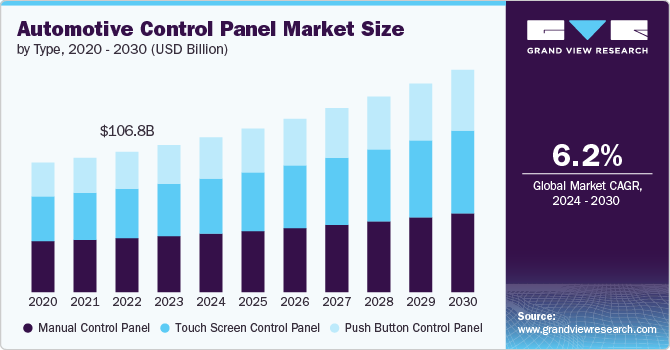
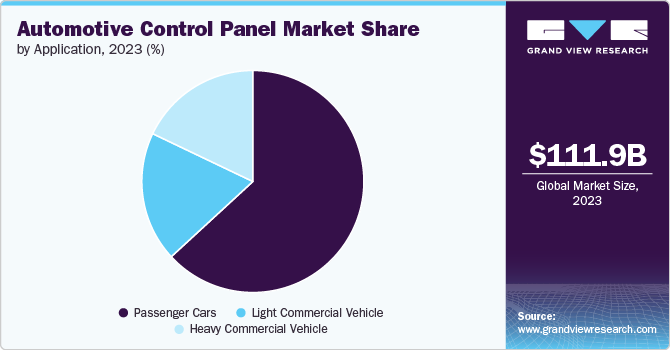
The global automotive control panel market was estimated at $111.92 billion in 2023 and is expected to grow at a CAGR of 6.2 percent from 2024 to 2030, according to Grand View Research. The firm also projects the global industrial automation and control systems market size, estimated at $206.33 billion in 2024, is projected to reach $378.57 billion by 2030.
With new “temporary” tariffs imposed, U.S. manufacturers remain in limbo regarding tariffs on new imports. Contracts forged at the beginning of 2026 may be revisited or buyers may delay purchasing until tariff issues are settled. Based on several reports on the industrial control market, the only certainty right now is demand will continue to grow.