NEMA 3 Enclosures: What They Are and How the Subtypes Compare
March 17, 2026
By Josiah Haas, President, Bud Industries
If you work with electrical equipment outdoors, you’ve probably come across the term “NEMA 3” more than once. It’s one of the most popular enclosure ratings in the industry — but with subtypes like 3R, 3S, and 3X in the mix, it’s easy to feel lost. Here’s a straightforward guide to what NEMA 3 enclosures do, how they’re tested, and what sets each subtype apart.
NEMA ratings are set by the National Electrical Manufacturers Association and define how well an enclosure protects the equipment inside from environmental hazards. The NEMA 3 rating is a go-to choice for outdoor applications because it strikes a solid balance between protection and cost.
A standard NEMA 3 enclosure protects against:
- Windblown dust and falling dirt — keeping airborne particles out of sensitive components.
- Rain, sleet, and snow — shielding equipment from common weather events.
- Ice formation — the enclosure itself won’t be damaged by ice buildup on its exterior.
- Accidental contact — preventing people or objects from reaching the equipment inside.
That said, NEMA 3 is not designed to handle hose-directed water, prolonged submersion, or explosive environments. If your application involves any of those, you’ll want to look at NEMA 4 or higher.
How Is NEMA 3 Tested?
Certification isn’t just a label — it requires passing a series of specific tests. A rod of defined diameter is used to confirm nothing can physically reach the interior. A water spray at roughly 5 PSI is directed at the top and sides to simulate rain with wind. Dust tests verify particle resistance, and an icing test confirms that ice formation neither penetrates the enclosure nor prevents it from functioning. Materials are also evaluated for UV resistance, since these enclosures are meant to live outside.
What are the differences between NEMA 3 and NEMA 3R, NEMA 3X and NEMA 3R?
Here’s where it gets interesting. The NEMA 3 family isn’t one-size-fits-all. Each subtype trades off a feature or adds one, depending on what your environment demands.
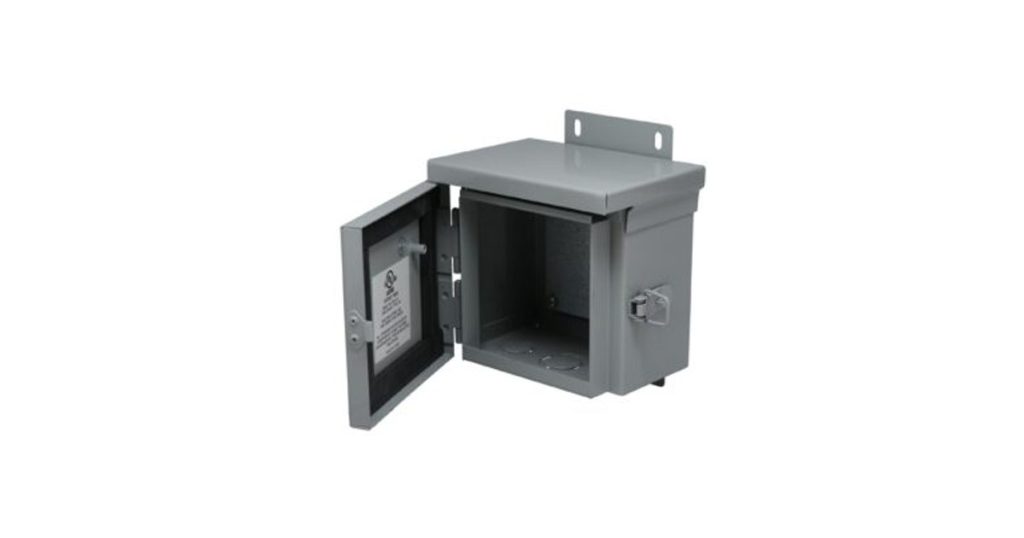
NEMA 3R drops the dust protection requirement. Because of this, 3R enclosures don’t need a dust-tight gasket — though many manufacturers include one anyway. The trade-off? 3R enclosures are required to have a drainage hole (sometimes called a weep hole) to prevent liquid from pooling inside. This makes them a popular, cost-effective choice for electrical panels and junction boxes in sheltered outdoor locations where dust isn’t a major concern but condensation is. Bud’s NEMA 3R steel enclosure is a popular choice for these locations.
NEMA 3S adds a unique capability: all external mechanisms — handles, locks, and latches — must remain operable even when covered in ice. The standard NEMA 3 enclosure only requires that ice not damage it; 3S requires that it remain usable under icy conditions.
NEMA 3X (and its relatives, 3RX and 3SX) layers corrosion resistance on top of whatever base rating it’s paired with.
When does using a NEMA 3 enclosure make sense?
If dust is a concern, then NEMA 3 is a good choice. If the enclosure needs drainage and is located in a sheltered spot, then NEMA 3R is a better option. Over-specifying wastes money. Under-specifying leads to early failure. Match the rating to your conditions, and your equipment will be fine.