The 5 Common Mistakes in Arc Flash Studies

May 19, 2026
The topic of “arc flash,” also called an “electrical arc,” is no longer reserved for very large industrial sites. As soon as a panel is opened, an operation is performed, or work takes place near exposed energized parts, the risk of an electrical arc becomes a real hazard, with potentially severe thermal, optical, acoustic, and mechanical consequences.
In the field, many studies present major inconsistencies. Frequent mistakes in arc flash studies rarely come from a lack of tools. They are linked to data quality, network understanding, and interpretation of the results.
This article will analyze in detail the 5 common mistakes in arc flash studies, their real impacts, and practical methods to avoid them.
Why flash arc studies are strategic today
Modern electrical networks are more complex than ever.
Photovoltaic generation, energy storage, generators, multi-source architectures: every addition modifies short-circuit levels and therefore incident energy levels.
An electrical arc can reach temperatures above 20,000 °C. The consequences include severe burns, equipment destruction, operational downtime, and liability for the operator.
Standards such as IEEE 1584 for incident energy calculation, IEC 61482 for protective clothing, NFPA 70E for electrical safety in the workplace, and NF EN 50110 for electrical operations now strongly regulate industry practices.
A reliable arc flash study is therefore a key tool for controlling industrial risk.
What is a flash arc study?
An arc flash study consists of calculating the thermal energy released during an electrical fault that generates an arc.
It makes it possible to determine:
• Incident energy in cal/cm²
• Arc flash boundary distance
• Required PPE levels
An electrical arc is created when current travels through the air between two energized conductors or between a conductor and ground. It may be caused by an insulation fault, human error, contamination, or equipment aging.
The objective of the study is to quantify this phenomenon in order to protect people.
The 5 common mistakes in arc flash studies
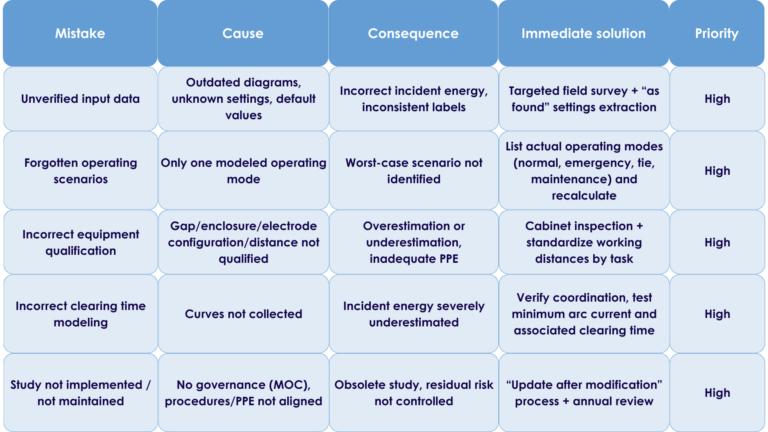
Mistake 1: Working with incomplete or unverified input data
Typical cause: the study is produced from a “documentation” single-line diagram or an incomplete as-built file, without an “as built” survey and without “as found” extraction of protection settings.
Technical consequence: calculated short-circuit currents, arc currents, and clearing times deviate from reality, making incident energy inconsistent. An arc flash study follows a methodology where data collection is the first step before any calculation.
Field example: a modular circuit breaker has been replaced with a different model during procurement, with a different curve and breaking capacity, but the model is not updated in the study. The label indicates “low” energy, while the actual selectivity increases the clearing time.
Useful comparison: approximate data may be tolerated in a load flow study, but it becomes critical in arc flash because arc duration directly depends on the protection device and its settings.
Mistake 2: Forgetting operating modes and worst-case scenarios
Typical cause: the study is calculated only in normal operating mode (open tie, single source), without analyzing alternative configurations: closed tie, emergency operation, generator mode, or multiple contributions.
Consequence: the study does not guarantee that the worst-case scenario has been identified. Calculation methodologies explicitly recommend determining operating modes.
Modern arc flash analysis tools highlight the resolution of multiple scenarios in order to identify the most severe levels, which reflects a real need on networks with variable configurations.
Field example: a commercial site adds a backup generator and modifies the tie configuration. The arc flash study remains unchanged. During a test, the closed tie increases the available current and changes the upstream trip behavior, modifying the incident energy at the switchboard level.
Useful comparison: a single-scenario study is fast and inexpensive, but it creates a false sense of compliance if the actual operating mode used (maintenance, testing, emergency operation) is not the one modeled.
Mistake 3: Incorrect equipment qualification (gap, enclosure, electrode configuration, working distance)
Typical cause: default parameters are used without verification: conductor gap, enclosure size, electrode configuration, and actual working distance. However, working distance is critical: a variation of just a few centimeters can significantly change incident energy.
Consequence: even with correct currents, the calculated incident energy becomes questionable. In recent models, identifying the electrode configuration is a key step.
Field example: on a low-voltage cabinet, using an inappropriate electrode configuration (or a “non-representative” enclosure) can change the estimate and therefore the PPE requirement, creating either overprotection (impractical for daily use) or underprotection (dangerous).
Useful comparison: in audits, “enclosure and electrode” discrepancies are often faster to correct than rebuilding the entire model, but they require a serious site visit and proper equipment qualification.
Mistake 4: Underestimating actual clearing time and ignoring the minimum arc current scenario
Typical cause: catalog trip times or theoretical settings are used instead of actual settings, or only a maximum nominal arc current is tested.
Major consequence: incident energy depends on both current and time. Upstream protection time-current curves are a major factor in arc duration, and the risk may increase at lower current if the protection device trips more slowly.
Field example: a relay is set with an instantaneous threshold above the available arc current.
Result: no instantaneous trip, transition into the time-delay zone, and incident energy skyrockets. Technical documents on coordination remind us that an instantaneous threshold set too high relative to the arc current prevents the expected energy reduction.
Useful comparison: a conventional short-circuit study is not sufficient. The optimal setting for selectivity is not automatically optimal for arc flash, which is why coordination studies and arc flash studies must be aligned.
Mistake 5: Producing a study document without operational implementation or update governance
Typical cause: the final deliverable stops at the report and a few labels, without alignment with procedures (lockout/tagout, access), qualifications, PPE renewal, and a process for updates after modifications.
Consequence: the study is accurate on day one, then gradually drifts away from reality. From a regulatory perspective, work near energized equipment may only be carried out by qualified personnel, and the employer must ensure appropriate training and procedures.
Regarding PPE, IEC 61482-2 defines a thermal protection scope and does not cover, for example, electric shock or protection for hands and face, which must be addressed through additional requirements and equipment.
Field example: arc-rated PPE is purchased, but face shields, gloves, and procedures are not consistent with the arc zones and actual tasks performed, even though arc flash also generates intense light, pressure, debris, and noise.
Useful comparison: a label alone is not risk control. Risk control comes from integration: labeling, procedures, briefings, inspections, and updates.
Comparison table of the 5 errors
Methodology and practical solutions
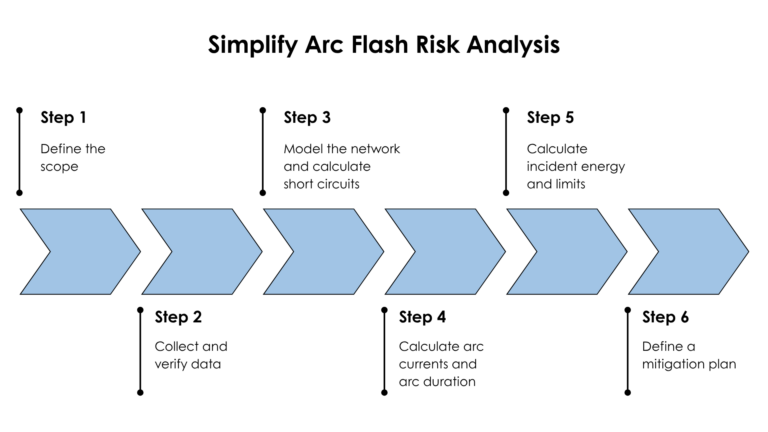
A robust arc flash study follows a logical sequence. It is not just a calculation, but a decision-making chain that goes from data to field action.
Step 1: define the scope. Identify the affected switchboards and cells, the actual tasks (switching operations, measurements, tightening, diagnostics), and the operating modes.
Step 2: collect and verify the data. Record transformers, cables, protection devices, actual settings, diagrams, and confirm the open/closed status of tie connections. This is the foundation for everything that follows.
Step 3: model the network and calculate short circuits. The short-circuit current (Ibf) is a major input parameter for arc calculations.
Step 4: calculate arc currents and arc duration. Protection devices, their curves, and their scenarios must be integrated, including cases where lower arc current extends trip time and increases energy.
Step 5: calculate incident energy and boundaries, then present the results in an operational format. The software must generate labels, but above all decisions (PPE, distances, intervention constraints). Software vendors emphasize multi-scenario calculation and label generation, but this does not replace field validation.
In this context, using tools capable of simultaneously handling arc flash calculations, operating scenarios, and protection analysis improves study reliability while making it truly usable. For example, environments such as the arc flash module integrated into elec calc make it possible to work directly on a consistent electrical model linked to actual settings and network configurations, which significantly limits discrepancies between calculations and field reality.
Step 6: define a risk reduction plan. Several strategies exist, particularly reducing clearing time and adjusting settings consistently with the available arc current.
Limitations and points of attention
An arc flash study is not a measurement but an estimate based on models. Arcs involve a degree of variability: some technical documents explain tolerances and the need to evaluate boundaries (minimum/maximum arc current) in order to control the risk.
PPE standards cover a specific scope. IEC 61482-2 addresses thermal hazards; it does not cover electric shock or all body parts (hands, face, feet), which require additional equipment and requirements.
The risk is not only thermal. Effects such as pressure waves, intense noise, flying debris, and light can create additional injuries. An arc flash study focused only on cal/cm² may miss these dimensions if it is not accompanied by organizational and technical measures.
Finally, the study does not replace operational safety rules. Standards for safe operation and maintenance apply to all work and maintenance procedures on or near electrical installations.
Conclusion
Arc flash studies are a powerful prevention tool, but they are highly sensitive to assumptions. The five most common mistakes are identifiable and correctable: data quality, scenarios, equipment qualification, realistic clearing time, and operational implementation.
The key point is comparative: a study that is correct in the model but wrong in actual operation is a risk. Conversely, a study aligned with real operating modes, real settings, and real tasks becomes a driver of safety, compliance, and maintenance performance.
In this logic, relying on tools capable of linking electrical modeling, arc flash calculation, and actual operating conditions becomes a key factor for ensuring long-term study reliability. Dedicated solutions such as the elec calc arc flash module make it possible to work on a consistent and usable model while limiting discrepancies between theory and field reality.

https://www.trace-software.com/en/technical-the-5-common-mistakes-in-arc-flash-studies/