

800 VDC and the Race to Power the AI Factory
August 27, 2026
By: Maurizio Di Paolo Emilio, Contributing Editor at Panel Builder US
Artificial intelligence is pushing data-center power architectures into territory they were never designed to handle. As AI accelerators become more powerful, rack power is moving from tens of kilowatts toward hundreds of kilowatts and, ultimately, the 1 MW range. At that scale, delivering electricity efficiently is no longer simply a matter of selecting better power components. It becomes a system-level architectural challenge.
One of the most significant responses is the move toward 800 VDC distribution. NVIDIA is developing an 800 VDC architecture intended to support 1 MW-class racks and beyond, while large AI infrastructure projects are driving demand for power capacity measured in multiple gigawatts.
Why higher voltage matters
The basic reason for increasing the distribution voltage is simple: higher voltage is lower current for the same power.
A 1 MW load supplied via an 800 V bus requires ~1250 A. To provide the same power at 54 V would need more than 18,500 A. Such currents have important implications for conductors, interconnects, resistive losses, thermal management, and the physical size of the power delivery system.
These are no longer secondary considerations in megawatt-level engineering. They directly affect the feasibility, efficiency, cost and physical footprint of the data center.
That is why 800 VDC should be seen as more than a replacement for a conventional intermediate bus. This is part of a bigger shift in how power flows from the electrical grid to the processor.
From the grid to the GPU
The emerging architecture can be viewed as a continuous power-conversion chain: medium-voltage AC is converted to an 800 VDC backbone, which then feeds rack-level conversion stages before power is delivered to processors at very low voltages.
This architecture also creates opportunities to rethink what happens upstream of the rack. Modular solid-state transformer concepts, for example, are being developed to convert medium-voltage grid power directly to an 800 VDC output. Siemens and Reinhausen have been working on a system capable of interfacing with grid voltages up to 36 kV.
The objective is straightforward: reduce unnecessary conversion stages while increasing efficiency and power density.
Every additional conversion stage brings its own semiconductor losses, magnetics, capacitors, control circuitry, thermal requirements, and physical volume. Eliminating even one stage can therefore have a meaningful impact – provided the remaining architecture can handle the voltage, current, transient response, isolation, and efficiency requirements.
Where GaN and SiC fit
This evolution does not necessarily create a competition in which one wide-bandgap technology replaces the other. Instead, GaN and SiC can occupy different positions along the power path.
SiC is particularly attractive in the higher-power portion of the architecture, where high voltage, thermal performance, and ruggedness are critical. It can therefore play an important role in the conversion between incoming AC power and the 800 VDC distribution bus.
GaN becomes increasingly interesting closer to the processor. Once 800 VDC reaches the server, the challenge changes completely: the system must generate extremely low voltages at enormous currents while responding rapidly to processor load transients.
GaN’s fast switching capability and low switching losses make high-frequency operation possible, helping reduce the size of magnetic components and other passive elements.
As Alex Lidow, CEO of EPC, recently explained, the emerging architecture could see SiC handling the higher-power conversion outside the server while GaN takes over inside the server after the 800 VDC bus arrives.
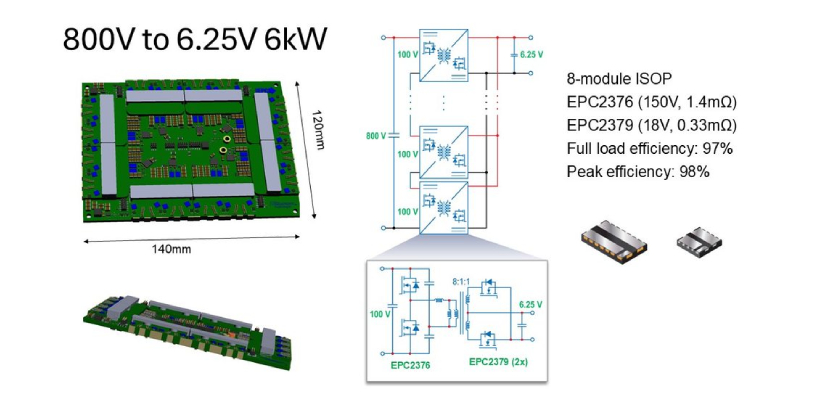
One architecture attracting attention is the input-series, output-parallel (ISOP) approach. Multiple lower-voltage converter cells can be connected in series on their inputs while their outputs are combined in parallel. Eight 100 V-to-12 V stages, for example, can collectively process an 800 V input while delivering a 12 V output.
The advantage is that designers do not necessarily need a single semiconductor device rated for the full bus voltage. The architecture can also scale to higher input voltages by increasing the number of series-connected stages.
Efficiency becomes a thermal problem
At megawatt scale, efficiency figures that appear impressive on a datasheet can translate into very large thermal loads.
A 1 MW rack operating at 98% efficiency still dissipates approximately 20 kW. At 99%, the loss drops to about 10 kW. A one-percentage-point improvement therefore represents roughly 10 kW of additional heat that does not have to be removed.
This makes electrical and thermal design increasingly inseparable.
Liquid cooling is already becoming essential for high-performance AI computing, but cooling systems also consume power, occupy physical space, and introduce additional infrastructure. The goal therefore cannot simply be to maximize semiconductor efficiency in isolation. The entire energy path must be optimized.
From compute scaling to power scaling
For years, AI infrastructure has been driven by advances in processors, accelerators and networking. The next stage may be defined as much by the infrastructure supplying those devices.
Moving to 800 VDC solves one of the first problems that increasingly dense AI computing creates: how to move massive amounts of electrical power through limited physical space.
But 800 VDC is probably not the end of the story. It is best considered one part of a larger grid-to-GPU architecture that may include medium-voltage conversion, high-voltage DC distribution, high-frequency GaN converters, SiC-based power stages, advanced packaging, and liquid cooling.
As rack power reaches megawatt levels and AI campuses reach multi-gigawatt capacities, power electronics become part of the computing architecture itself.
In the future, the AI factory will be judged not by how many GPUs it can throw at a problem, but how efficiently it can turn electricity into computation.