

Liquid Cooling: Redesigning the Thermal Architecture of AI Data Centers
September 9, 2026
The rapid deployment of AI accelerators is changing one of the fundamental design constraints of the data center: thermal management. As GPUs and CPUs become more powerful and rack-level power density continues to increase, conventional air cooling is approaching the limits of what it can practically remove from high-density computing systems.
Liquid cooling is therefore moving from a specialized technology to a key element of next-generation data center architecture. The transition, however, is not simply a matter of replacing fans with pumps. It requires a different approach to heat transfer, coolant distribution, monitoring, power infrastructure and facility design.
From air cooling to direct heat extraction
Air cooling works well when the heat generated by individual components and servers remains within manageable limits. Heat is transferred from the semiconductor package to a heatsink and then into the surrounding air. Fans move the heated air toward the facility cooling system.
The fundamental limitation is the relatively low heat-transfer capability of air. Increasing airflow can remove more heat, but doing so requires larger fans, higher airflow rates and additional electrical power. At sufficiently high power densities, airflow, pressure drop, heatsink size and acoustic constraints become increasingly difficult to manage.
Liquid offers a substantially higher volumetric heat capacity and thermal conductivity than air. Instead of transferring heat from the semiconductor into a large volume of moving air, a liquid cooling system can capture heat much closer to its source.
This is the principle behind direct-to-chip cooling.
Direct-to-chip cooling
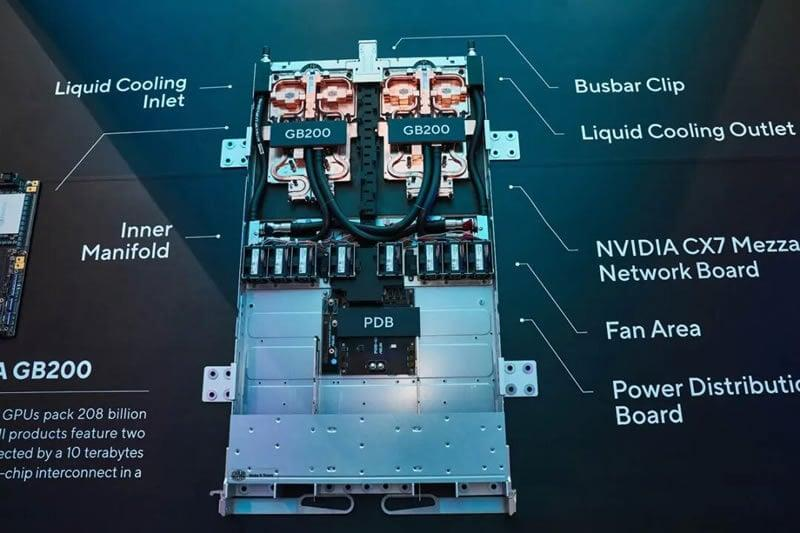
In a direct-to-chip architecture, a cold plate is mechanically coupled to the CPU or GPU package. A coolant flows through internal channels in the cold plate, absorbing heat from the semiconductor and transporting it to a distribution system.
A typical thermal path can therefore be represented as:
GPU → thermal interface material → cold plate → coolant → manifold → CDU → facility cooling system
The shorter and more controlled thermal path is one of the major advantages of this architecture.
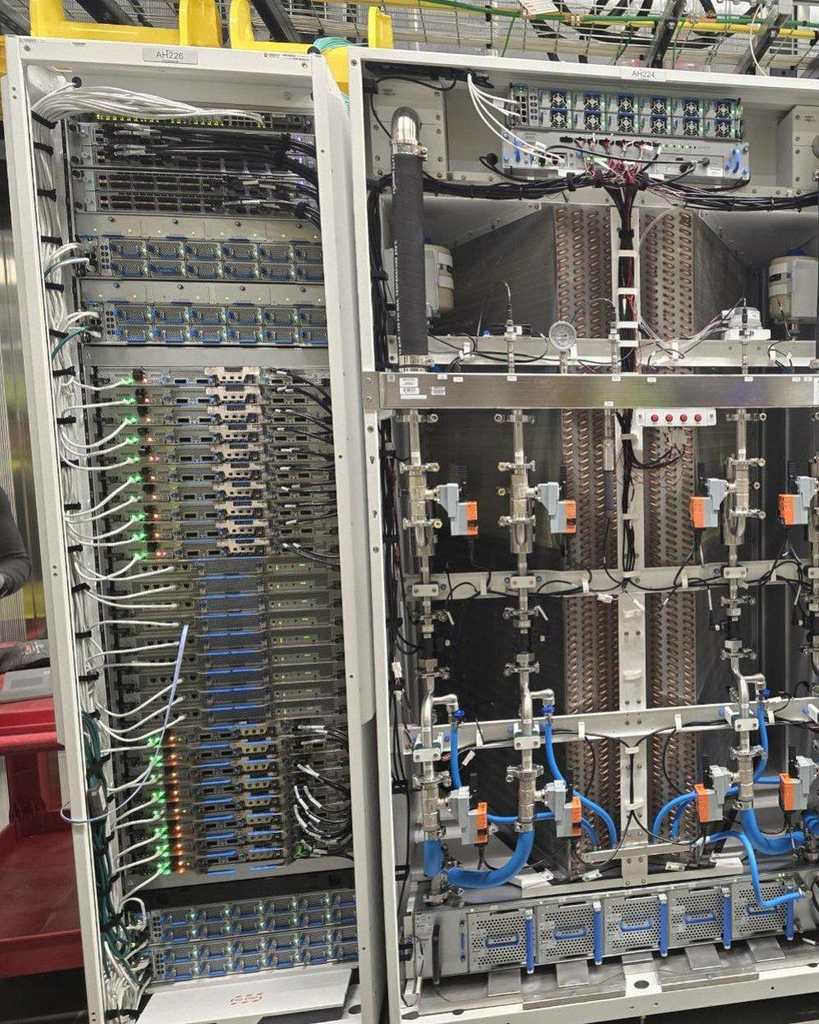
The Coolant Distribution Unit, or CDU, is particularly important because it separates the technology cooling loop from the facility water loop. It can control coolant temperature, flow and pressure while providing heat exchange between the two circuits.
This separation also becomes important for reliability. The coolant circulating close to sensitive electronic components must meet specific requirements for cleanliness, chemistry, materials compatibility and operating conditions.
Rack-scale thermal engineering
The increasing importance of liquid cooling is closely connected to the evolution of AI computing architectures. The industry is moving from relatively conventional servers toward highly integrated accelerator systems in which dozens of GPUs and CPUs can operate within a single rack. The result is a dramatic increase in heat generation concentrated in a small physical volume.
Thermal management consequently has to move from the individual server level toward the rack level. A rack is increasingly becoming a thermal system in its own right, with liquid distribution, manifolds, pumps, heat exchangers, sensors and control electronics working together.
This also changes how data centers are designed. Cooling capacity can no longer be considered independently from the compute architecture. The electrical power delivered to a rack, the heat generated by its processors and the facility’s ability to remove that heat become tightly coupled engineering parameters.
Direct-to-chip versus immersion cooling
Direct-to-chip is not the only liquid cooling approach.
Immersion cooling places electronic components in a dielectric fluid. In single-phase systems, the fluid remains liquid throughout the process and is circulated through a heat exchanger. In two-phase systems, the fluid vaporizes when it absorbs heat and subsequently condenses.
Immersion can provide very high heat-transfer capability and potentially eliminate some of the conventional server-level cooling infrastructure. However, it introduces additional considerations involving fluid selection, material compatibility, maintenance, component servicing and system integration.
For this reason, direct-to-chip cooling currently represents a particularly practical approach for high-density AI infrastructure, especially where existing server and data-center architectures must evolve rather than be completely replaced.
Thermal management and power delivery converge
One of the most important consequences of higher compute density is that thermal design can no longer be considered separately from electrical design.
A high-density AI rack may require hundreds of kilowatts of electrical power. Delivering this power efficiently creates its own thermal losses in power supplies, converters, busbars, connectors and distribution equipment.
The architecture therefore becomes a coupled system:
Grid → power conversion → rack power distribution → voltage regulation → AI accelerator → heat generation → liquid cooling → facility heat rejection
This relationship is particularly relevant to the evolution toward higher-voltage DC architectures. As rack power increases, distributing power at higher voltage can reduce current for a given power level, potentially reducing resistive losses and conductor requirements.
Power semiconductors consequently become part of the broader thermal equation. GaN and SiC devices, for example, can enable higher switching frequencies, power density and efficiency in selected power-conversion stages. Their value in AI infrastructure should therefore be evaluated not only through semiconductor performance, but through the system-level interaction between electrical efficiency and thermal design.
Water, temperature and energy efficiency
Another important advantage of liquid cooling is the possibility of operating cooling systems at higher temperatures.
If the coolant leaving the electronics is sufficiently warm, the facility may be able to reject heat with reduced reliance on mechanical refrigeration. Depending on climate, architecture and operating conditions, this can improve overall energy efficiency.
Water consumption is also becoming an important design parameter for large data centers. The objective is no longer simply to achieve the lowest possible chip temperature. Engineers increasingly need to optimize the complete thermal system, balancing chip temperature, coolant temperature, flow rate, pumping power, heat-rejection efficiency and water usage.
This makes thermal management a system optimization problem rather than a component-level problem.
The next challenge: controlling the thermal system
As liquid cooling becomes more widespread, sensors and control systems will become increasingly important.
Flow rate, inlet and outlet temperature, pressure, coolant quality and leak detection all need to be monitored. At rack scale, the cooling infrastructure must respond dynamically to changes in computational workload.
This creates another layer of engineering complexity: the thermal system must be capable of following rapidly changing electrical and computational loads while maintaining safe operating conditions.
Ultimately, liquid cooling is not simply replacing air cooling. It is becoming part of the infrastructure that enables higher compute density.
The transition from air to liquid therefore represents a broader architectural change. AI accelerators are driving higher electrical power density; higher power density generates higher heat flux; and higher heat flux requires shorter, more efficient thermal paths.
The result is a convergence of semiconductors, power electronics, thermal engineering and data-center infrastructure.
The next generation of AI data centers will consequently be designed not only around how much computing power a rack can deliver, but around how efficiently that electrical power can be converted into computation—and how effectively the resulting heat can be removed.