

Wide Bandgap Materials in Hybrid and Electric Vehicles
August 27, 2026
Introduction
For decades, power electronics have relied predominantly on silicon, a semiconductor material that lends itself to essentially defect-free processing. Silicon’s theoretical performance ceiling, however, has now largely been reached, exposing several shortcomings: constrained voltage-blocking capacity, limited thermal dissipation, capped efficiency, and non-trivial conduction losses. Wide bandgap (WBG) semiconductors — chiefly silicon carbide (SiC) and gallium nitride (GaN) — deliver superior characteristics relative to silicon, including higher efficiency, faster switching frequencies, and the ability to operate at elevated temperatures and voltages.
Because EVs and HEVs incorporate multiple stages of power conversion, cumulative losses across these stages can consume up to 20% of the power initially supplied. WBG semiconductors substantially raise the efficiency of these conversion stages, making them an effective replacement for silicon in voltage converters, power MOSFETs, and high-efficiency Schottky diodes. Relative to both silicon (Si) and gallium arsenide (GaAs), WBG semiconductors offer notable gains: improved power efficiency, reduced size and weight, and lower total cost.
Benefits of GaN and SiC
WBG materials are characterized by a comparatively wide energy bandgap — the energy difference separating the top of the valence band from the bottom of the conduction band. Electrons cross this gap into the conduction band when subjected to thermal or optical excitation, and the bandgap governs a semiconductor’s ability to toggle between conducting (ON) and blocking (OFF) states in response to externally applied electrical parameters. Silicon carbide and gallium nitride possess bandgaps of 3.3 eV and 3.4 eV respectively — substantially wider than silicon’s 1.12 eV or gallium arsenide’s 1.4 eV. A broader bandgap corresponds to a higher electric breakdown field, which in turn permits operation at greater temperatures, voltages, and frequencies, and also translates into an elevated breakdown voltage. By exceeding silicon’s theoretical ceiling, GaN and SiC devices maintain efficient, dependable operation even under demanding conditions. Their principal advantages over silicon include:
- Reduced on-resistance
- Increased breakdown voltage
- Improved thermal conductivity
- Capability to operate at higher temperatures
- Enhanced reliability
- Reverse recovery time approaching zero
- Strong performance at high frequencies
SiC automotive applications
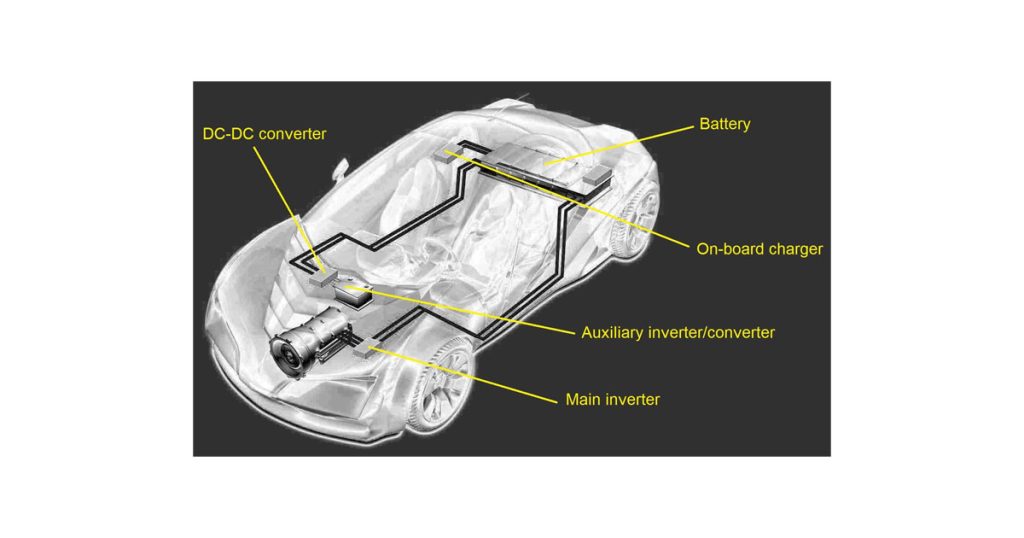
Figure 1 illustrates the principal power components found in electric and hybrid vehicles, all of which can be efficiently realized using SiC-based devices in place of silicon. The main inverter is central to vehicle operation: it drives the electric motor — whether synchronous, asynchronous, or brushless DC — and recovers energy from regenerative braking, returning it to the battery. The DC-DC converter, meanwhile, steps down power from the high-voltage battery to supply the vehicle’s 12V system. The market currently offers high-voltage batteries spanning various voltage levels and power classes, typically between 1kW and 5kW. Depending on whether the regenerative circuitry needs to support one-way or two-way energy flow, additional components may be needed.
An auxiliary inverter/converter draws power from the high-voltage battery to run systems such as air conditioning, electric power steering, PTC heaters, and oil and cooling pumps. The battery management system oversees the battery’s condition throughout charge and discharge cycles, an operation that must be handled intelligently to maximize battery longevity — as cells age, their use during charging and discharging must be rebalanced accordingly. The on-board charger is equally critical, enabling the battery to be recharged from an ordinary power outlet; this demands that a single circuit accommodate a range of voltage and current levels. Designers must also plan for future functionality, such as bidirectional power flow that would let the vehicle feed energy back into the smart grid.
GaN motor driver
Automotive electric motors are trending toward smaller footprints and higher performance, a combination that traditional MOSFET- and IGBT-based motor drivers increasingly struggle to deliver. Silicon technology is nearing its theoretical boundaries, particularly with respect to power density, breakdown voltage, and switching frequency — constraints that directly drive up power losses. These limitations chiefly manifest as reduced efficiency, compounded by difficulties operating at high temperatures and rapid switching rates.
For instance, a silicon-based power device switching at 40 kHz or above will experience switching losses that exceed its conduction losses, amplifying overall power loss. Dissipating this excess heat requires a heat sink, which adds cost, weight, and bulk to the device. High Electron Mobility Transistor (HEMT) devices built on gallium nitride offer superior electrical properties, positioning them as a strong alternative to silicon MOSFETs and IGBTs in motor-control applications demanding high voltage and high switching frequency. By comparing total power losses for silicon- and GaN-based devices, we find out that conduction losses remain roughly constant across both materials, but switching losses diverge sharply. GaN HEMT transistors exhibit markedly lower switching losses than silicon MOSFETs or IGBTs as frequency rises, with the gap widening further at higher switching frequencies.
Conclusion
With MOSFETs and IGBTs approaching their theoretical performance limits, silicon carbide and gallium nitride are gaining ground thanks to properties such as low on-resistance, high thermal conductivity, high breakdown voltage, and high saturation velocity — establishing themselves as the most efficient, compact, and lightweight technologies for meeting the demands of EVs and HEVs.