Selecting an IP67 Enclosure for Outdoor Electronics Applications
April 14, 2026
By Josiah Haas, President, BUD Industries
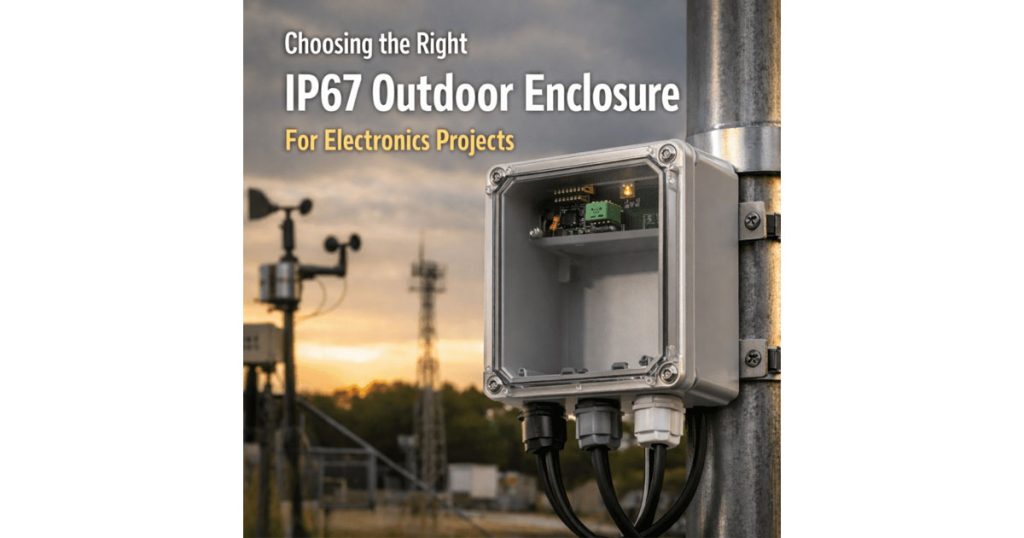
When protecting outdoor electronics, your choice of enclosure is more than just a box, it’s a critical component of the system’s longevity. Outdoor environments are truly unforgiving including being around moisture, dust, and extreme temperature swings that can degrade sensitive components if the housing isn’t up to the task. (Frankly, this is where BUD Industries excels…)
At its core, IP67 is a standard defined by the International Electrotechnical Commission (IEC) that classifies the degree of protection an enclosure provides against “ingress.” The first digit, the “6,” represents the highest level of dust protection, meaning the unit is completely dust-tight. The second digit, the “7,” signifies that the enclosure can withstand temporary immersion in water up to one meter deep for 30 minutes.
Essentially, an IP67 rating ensures that your electronics are protected against everything from windblown desert grit to a sudden flash flood or heavy rainstorm. Or for domestic terms it helps protect in the desert of West Texas and Arizona, the rainstorms in the Great Northwest states of Oregon and Washington, the frigid temperatures of upstate Minnesota or Maine, and along the Atlantic coasts of Maryland, North Carolina, or Florida where a box could be raised and lowered on a dock.
An IP67-rated enclosure is often the gold standard for these applications. It provides a total seal against dust and can withstand temporary immersion in water. However, a rating on a spec sheet doesn’t always translate into real-world performance once you start drilling holes or mounting the unit in the field.
Here is how to approach selecting the right IP67 housing for your next project. Each step is imperative if you are going to pick the correct enclosure for your application or project.
Choosing the Right Material: Polycarbonate vs. Aluminum
The material you choose dictates how your electronics will handle any physical or environmental stress.
- Polycarbonate and ABS: These are the go-to options when you need a lightweight, corrosion-resistant, and non-conductive housing. Polycarbonate IP67 enclosures are particularly popular for Wi-Fi and IoT sensors because they don’t interfere with wireless signals and are easy to machine for cable glands. The less metal in a Wi-Fi enclosure, the better. ABS plastic is a less expensive option but will not hold up as long as Polycarbonate when dealing with the elements. Based on UV stabilization, ABS often is used for more indoor applications. For engineers designing Industrial IoT (IIoT) sensors, polycarbonate is often the preferred choice over metal. Because it is RF-transparent, it allows internal antennas for Wi-Fi, LoRaWAN, and Bluetooth to maintain strong signal strength without the need for expensive external antenna modifications
- Die-cast Aluminum: If your application involves heavy industrial machinery or high-traffic areas, aluminum offers superior impact resistance. It also provides natural EMI/RFI shielding, which is vital for communication equipment or sensitive industrial controls. Powder Coating of a die-cast aluminum box can often assist in long term protection or moving an enclosure into an IP67 or even IP68 rating. A primary advantage of aluminum is its superior impact resistance, which is often measured by IK ratings. While plastic housings are susceptible to cracking under physical stress, a die-cast aluminum enclosure typically achieves an IK08 or higher rating, meaning it can withstand significant kinetic energy from tools, falling debris, or accidental collisions. This makes aluminum the preferred choice for “higher-traffic” industrial areas where mechanical durability is just as important as the environmental seal. By selecting a housing with a high IK rating, you ensure that the enclosure won’t just keep the water out, but will also maintain its structural integrity against the daily rigors of a factory floor or a public utility site.
- Please note some plastic or polycarbonate-fiberglass blended enclosures like BUD’s PTQ or PIP also have IK impact resistance. This could give you the best of both worlds with additional strength but some of the light weight features you are looking for in plastic.
Thermal Management
Beyond physical protection, engineers must account for the thermal profile of their electronics within a sealed environment. Because an IP67 enclosure is airtight, it also acts as a true insulator, trapping the heat generated by internal components like a power supplies or processors. This is known as the “oven effect.” To mitigate this without compromising the waterproof seal, you can utilize internal heat sinks or mount components directly to the walls of a die-cast aluminum enclosure to leverage its natural thermal conductivity.
For high-heat applications, selecting an enclosure with enough internal volume to allow for passive convection can be the difference between a stable system and a premature component failure. Heat dissipation cannot be overlooked!
Maintaining the Seal During Instalation
The moment you drill a hole in an IP67 enclosure, you have technically voided that rating by a certifying body. To keep your electronics dry, you must focus on the “weakest links”:
- Cable Glands and Connectors: Never leave an open hole. Use liquid-tight cable glands that match or exceed the IP67 rating of the box itself.
- Gasket Integrity: Ensure the silicone sponge, EPDM, or neoprene gasket is seated perfectly. If you are opening and closing the lid frequently during testing, check for any grit or debris that might compromise the seal.
- Precision Machining: Rough or uneven cutouts make it harder for gaskets to create a watertight seal. If you have high-volume needs, having the manufacturer provide custom enclosure modifications can ensure factory-level precision.
Heat, Condensation, and UV Exposure
An IP67 rating protects against liquid water, but it doesn’t always account for water vapor.
In outdoor settings, “solar loading” can cause the internal temperature of the enclosure to spike. When the sun goes down, that temperature drop can create a vacuum effect, pulling moist air in and causing internal condensation. To prevent this, consider adding a pressure-equalizing vent. These vents allow the enclosure to “breathe” without letting in dust or liquid.
Additionally, if your enclosure will be in direct sunlight, ensure the material is UV stabilized. This prevents the plastic from becoming brittle or yellowing over years of exposure. Candidly, many people who chose ABS plastic for outdoor applications will see the yellowing occur. It often can have what I see as a chalking or eraser effect that occurs where the box starts to show plastic shavings that are the ABS plastic breaking down over time when in the sun.
Layout and Scalability
It is tempting to choose the smallest enclosure possible to save on cost and space. However, internal heat buildup is a real concern in compact spaces.
When planning your internal enclosure layout, leave enough “bend radius” for your wiring and cabling. Cramming wires into a tight space puts stress on the connectors and makes field maintenance a headache. A slightly larger enclosure can provide better airflow and make future upgrades much easier.
Technical Note
While the IP rating system is the international standard for environmental protection, it is important to note that IP67 often aligns closely with the NEMA 6 rating typically used in North America. Both standards signify that an enclosure is designed to withstand temporary submersion in water and provide a complete seal against dust and debris. However, NEMA ratings do go a step further by accounting for factors like corrosion resistance and ice loading, which are not covered under the basic IP scale.
When your project specifications call for a NEMA 4X or NEMA 6 enclosure, selecting a high-quality IP67-rated polycarbonate or aluminum housing is often the most effective way to ensure cross-compatibility and rigorous protection in harsh industrial environments. As companies presence expand globally it is important to understand both NEMA and IP ratings to better allow you to partner with Electronic, electrical, or mechanical engineers on a given project.
Reliability Starts with Selection
An IP67 enclosure provides the foundation for a reliable outdoor system, but the details including material choice, proper venting, and high-quality cable entry will determine if it survives the season.