Grid-to-Chip Has a New KPI: Predictable Commissioning at AI Scale
By: Manav Patel, Vice President, Strategy & Business Transformation, Schneider Electric
AI data center expansion is forcing the industry to rethink what power capacity really means. The headline constraint is still megawatts and how quickly a site can secure them, but another pressure point is now just as decisive. Teams need to design, integrate, and commission the end-to-end electrical path, from utility transformer to primary and secondary distribution servers in pods and rows, with minimal schedule risk. Grid-to-chip execution is becoming a differentiator rather than a checkbox.
AI Loads Do Not Just Raise Demand. They Raise Integration Risk.
The power profile of AI servers differs fundamentally from traditional enterprise computing. GPU (graphics processing unit) based processing consumes far more power than CPU (central processing unit) centric environments, and it requires a commensurate increase in cooling power. Goldman Sachs Research projects that global data center power demand could be 165
percent higher in 2030 than in 2023, with AI drawing an increasingly significant share. Racks are climbing from ahistorical norms into far higher densities, potentially up to 1 MW (megawatt) per rack in the most demanding configurations. At that point, every downstream assumption about distribution architecture, protection coordination, and commissioning workload comes under pressure.
At these scales, problems do not stay local. A design decision at medium voltage or primary low voltage can ripple into rework in the white space, and it can trigger changes to protection settings, control sequences, or integrated testing windows. For teams bringing large blocks of capacity online repeatedly, those secondary impacts are often where schedules slip.
Reliability And Safety Need to Be Designed in Early

As AI data centers grow, the cost of a power event scales with them. Beyond direct downtime cost, a disruption can force the costly restart of massive batch computations, so a short power disturbance can become a major operational setback. That reality is shifting how teams approach reliability and safety, with more of those outcomes shaped through early architectural choices rather than late-stage validation.
For developers and operators, protection and controls coordination is easier to hold to schedule when it is built into the design from the outset rather than reconciled near the end.
Architecture Matters More Than Adding Equipment
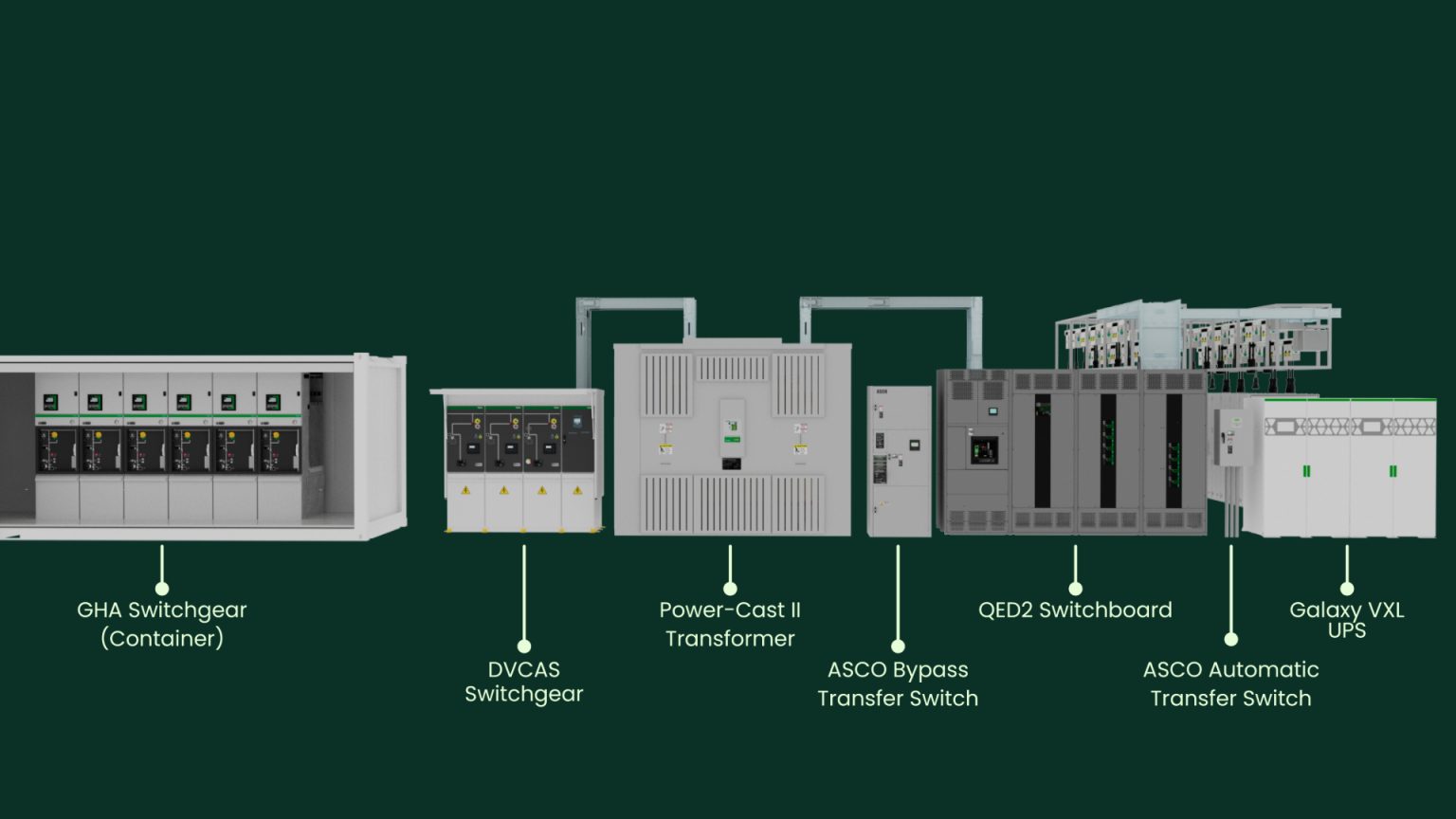
Across the power train, many teams report the same source of friction: more equipment, more interfaces, and more handoffs. Conventional data center powertrains typically start with utility-supplied medium-voltage power, transform it to low-voltage, and distribute it through uninterruptible power supplies, switchboards, and busway to rack-level IT loads. That model is proven, but AI workloads push it into territory where coordination burdens increase sharply. Adding redundant pathways and distribution segments also adds protection studies, commissioning steps, and opportunities for field variability.
Cloud-scale operators have already moved toward architectures that reduce some of that friction. In the Open Compute Project model, AC to DC conversion shifts from the server to the rack, often with 48 V battery arrangements that ride through generator start. The efficiency gains can look incremental, on the order of two to three percent, but in very large facilities, that translates into meaningful operational and cost impact, and it changes how systems are packaged and scaled. The pattern that emerges is that commissioning predictability is increasingly engineered into the architecture itself.
Prefabrication Is Shifting from Advantage to Requirement
One way to make commissioning more predictable is to move complexity off-site. Prefabricated, or modular, powertrains packaged into transportable, pre-engineered frames can reduce field labor constraints and variability. Factory assembly and testing can reduce quality issues and accelerate turnover because fewer functions are being proven for the first time on the job site.
The same logic applies in white space. Prefabricated pod approaches modularize not only racks, but also containment, busway, cooling distribution support, and network infrastructure. Speed is one benefit; repeatability is arguably the larger one, because standardized processes support predictable sequencing and fewer commissioning surprises. Some modular approaches report a 30 percent or more reduction in deployment timeline compared with traditional builds, along with cost savings of more than 15 percent. Taken together, these point to prefabricated and pre-tested delivery models becoming more central to AI expansion.
The New Grid-to-Chip Reality: Build Power Like a Product
AI data center growth is turning power delivery into an industrial scaling challenge. Teams are working to minimize on-site uncertainty by treating the electrical path as a repeatable system, one built on a clear architecture, standardized interfaces, integrated protection and controls, and modular execution.
Securing megawatts is essential, but it is no longer sufficient on its own. The larger objective is a powertrain that can be deployed, integrated, and commissioned predictably, again and again, at AI scale.
About the Author
Manav Patel is the Vice President of Strategy & Business Transformation at Schneider Electric, responsible for strategy across the company’s $6B+ Low Voltage business in North America. He brings more than 15 years spanning electrical power and digital infrastructure: he started in engineering on medium- and low-voltage switchgear and circuit breakers at Eaton, then moved into technology sourcing and product strategy for hyperscale data centers at Meta before joining Schneider Electric. His current focus is the power density surge driven by AI, including why these workloads are forcing a rethink of traditional distribution, how low-voltage DC architectures change total cost of ownership at scale, and what next-generation critical infrastructure strategy looks like in practice. He holds a master’s in electrical engineering from the University of North Carolina at Charlotte.