Ten Data Center Market Questions with Weidmuller
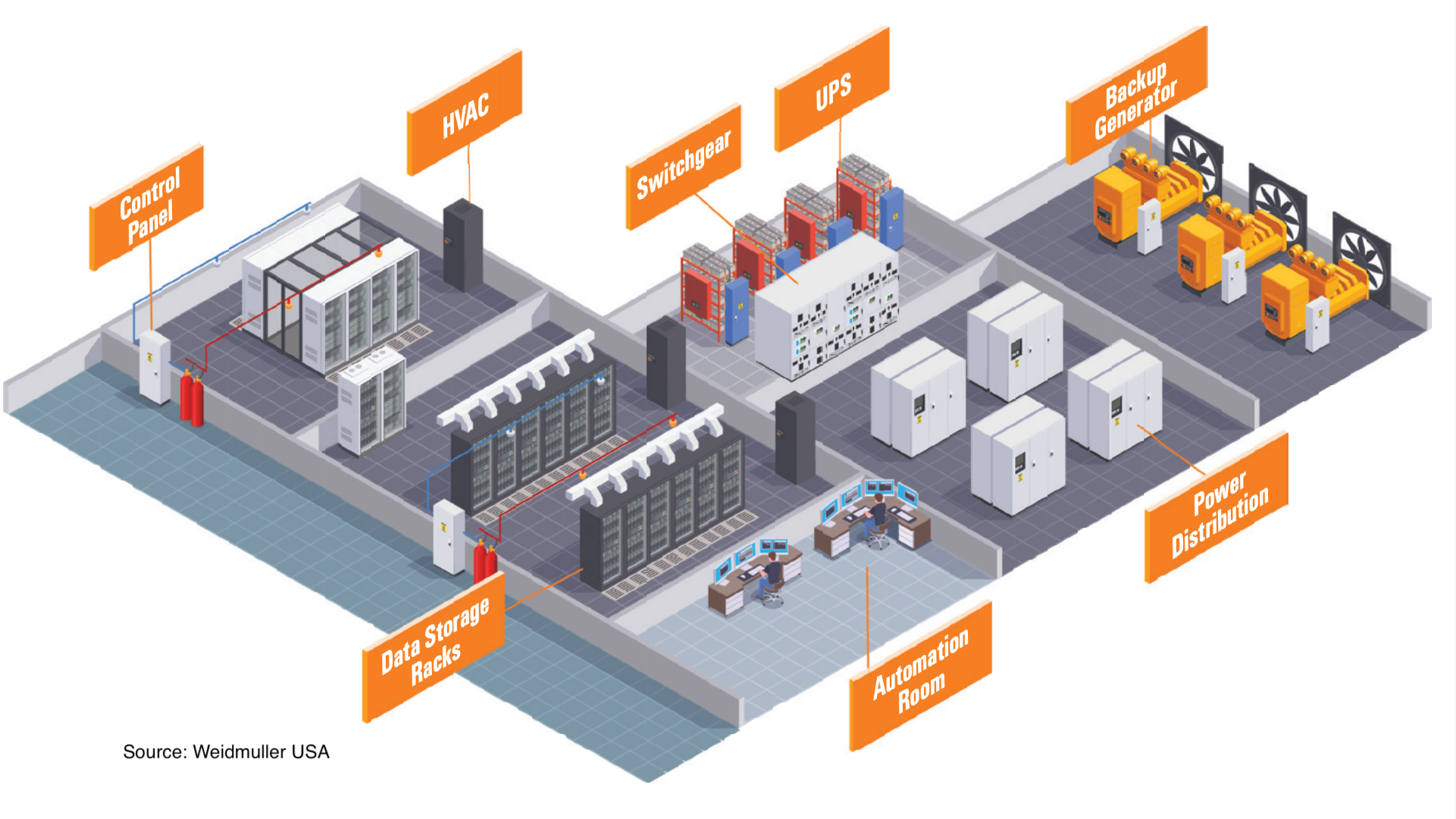
Data centers are evolving faster than ever — driven by rising energy demands, the push for sustainability, and the integration of AI and edge computing. To better understand how these shifts are shaping data center infrastructure, operations, and connectivity, Panel Builder US editor Garth Miller interviewed Pete Tecos, Director of Data Centers & New Energy, Weidmuller USA.
Q: What do you see as the most significant trends shaping the data center industry in 2026 and beyond, particularly regarding power constraints and market expansion to new regions?
A: Data centers are the critical infrastructure powering today’s digital economy—and in this space, every second counts. Accelerating deployment is no longer a luxury. The pressure to move faster is driven by several key factors:
- Surging Demand: Global data traffic is doubling at an unprecedented pace. AI workloads, 5G networks, and real-time analytics require enormous and ever-expanding computing capacity.
- Intensifying Competition: Cloud providers and colocation operators are in a race for land, power, and market share. Delays in deployment can lead to missed opportunities and lost revenue.
- Capital Pressure: Building a single hyperscale data center can cost over $1 billion. Faster commissioning directly translates to earlier returns on investment.
Traditional construction cycles of 18 to 36 months are no longer sustainable. Industry leaders are embracing modular, standardized, and scalable architectures to bring facilities online in less than a year. In today’s environment, speed to market is not just a strategic advantage—it is mission-critical.
Q: How is demand for data center capacity changing as a result of AI workloads and cloud computing, and what challenges does this create for infrastructure providers?
A: As the demand for fast, scalable data center deployment intensifies, a powerful combination of products, services, and digital capabilities tailored to today’s challenges enables data center developers to build faster, smarter, and more reliably across every phase of the project lifecycle.
Companies must be well-positioned to meet these evolving demands with modular, scalable solutions and advanced remote connectivity capabilities. From AI-powered diagnostics to seamless remote firmware updates, the growing portfolio of digital automation tools enables faster rollouts, smarter operations, and reduced on-site intervention. As infrastructure continues to decentralize, it’s never been more important to identify a trusted partner for building the agile, intelligent data centers of the future.

Q: In terms of application development, how are advances in digital engineering and automation impacting data center design and commissioning timelines?
A: Advances in digital engineering and automation are significantly compressing data center design and commissioning timelines by transforming traditional workflows into highly integrated, model-driven processes. Here’s how:
Digital Engineering Accelerates Design
- Model-Based Engineering: Instead of static drawings, engineers use digital twins and 3D models to simulate entire data center systems before physical build. This reduces design errors and rework.
- Integrated Design Platforms: Tools like Weidmuller Configurator and EPLAN allow electrical, mechanical, and network designs to be developed collaboratively in one environment, eliminating siloed workflows.
- Automated Documentation: Digital engineering platforms generate wiring diagrams, BOMs, and compliance documentation instantly, cutting weeks from the design phase.
Automation Speeds Commissioning
- Pre-validated Modules: Modular, pre-engineered assemblies (e.g., power distribution units, control panels) can be configured digitally and shipped ready for installation.
- Automated Testing & Simulation: Virtual commissioning uses simulation to test control logic and system behavior before hardware arrives, reducing on-site troubleshooting.
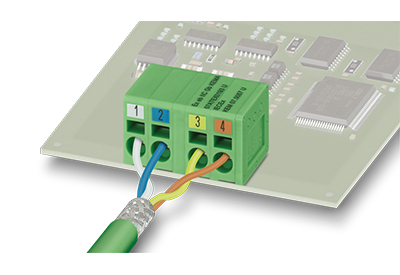
- Tool-Free Wiring (e.g., SNAP IN): Automation in connection technology minimizes manual labor and wiring errors, accelerating cabinet assembly and installation.
Impact on Timelines
- Design Phase: Digital engineering can reduce design cycles by 30–50% through automation and error prevention.
- Commissioning Phase: Virtual commissioning and modular systems can cut on-site setup time by up to 40%, enabling faster go-live for data centers.
Digital engineering and automation shift much of the complexity from the physical site to the virtual environment, enabling parallel workflows, fewer errors, and rapid deployment—critical for meeting the growing demand for data center capacity.
Q: Can you speak to the role of modular, pre-engineered solutions in current data center projects? How do these approaches accelerate deployment or improve outcomes?
A: Modular, ready-to-install solutions simplify field installation and reduce on-site labor by up to 50%. Key considerations include:
- Pre-Assembled Junction Boxes for power generation and electrical rooms.
- Control and I/O Systems for infrastructure automation.
- HDC Plug-and-Play Solutions for HVAC, lighting, and power monitoring systems.
By shifting labor off-site, these modular-based systems minimize field errors, accelerate commissioning, reduce installation time by 30–50% and enable consistent scalability.

optimize consumption and identify inefficiencies
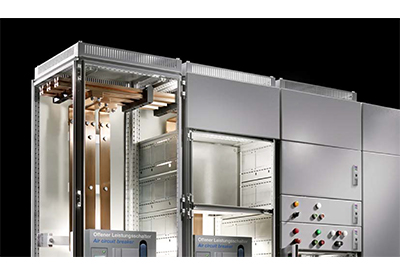
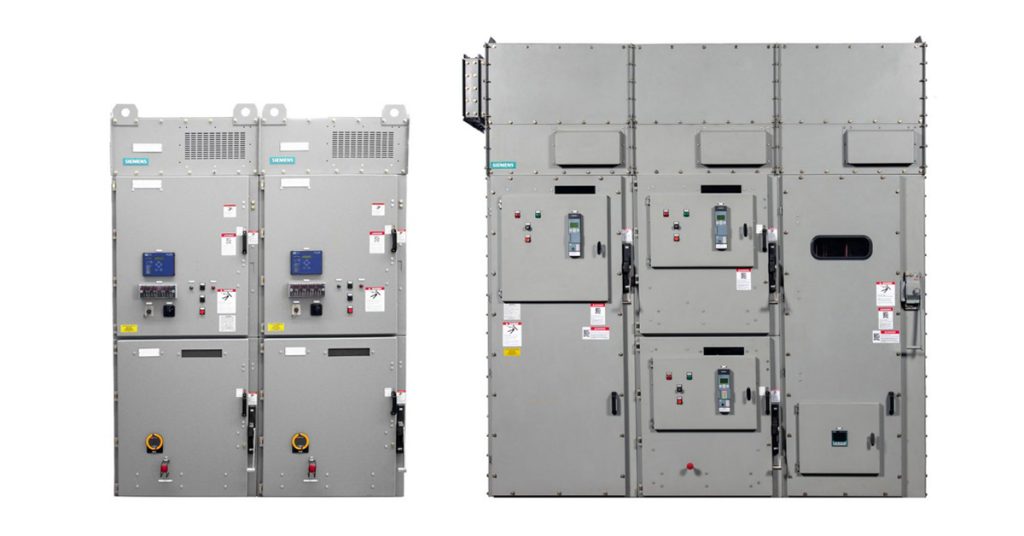
Case in Point: Modular Switchgear Assemblies
Power Connectors, DIN-rail Terminal Blocks, and Heavy-Duty Connectors—featuring the fastest connection technology on the market, SNAP IN technology—eliminate manual screw fastenings, enabling fast, tool-free assembly of switchgear. This speeds up deployment and simplifies maintenance and expansion.
Q: What are some of the new applications or customer demands driving the need for advanced power and signal infrastructure in data centers?
A: Modern data centers are increasingly intelligent, integrating IoT-based monitoring systems for power, cooling, fire suppression, and security. Industrial connectivity portfolios—including Industrial Ethernet, Signal Converters, Remote I/O, and Edge Devices—enables seamless integration of:
- Power Usage Effectiveness (PUE) Monitoring
- Environmental Controls (Temperature, Humidity, Airflow)
- Predictive Maintenance
The selection of solutions with multi-protocol support (Modbus, PROFINET, OPC UA, and MQTT), ensures interoperability across diverse systems, reducing the time needed for custom integration.
Q: How do Weidmuller’s products and solutions address the challenges of energy efficiency, speed to market, and system reliability in today’s data centers?
A: Weidmuller’s products and solutions are designed to tackle the key challenges faced by modern data centers: energy efficiency, speed to market, and system reliability. This is accomplished through a combination of innovative connection technologies, automation, and digitalization. Here’s how:
Energy Efficiency
- Low-Loss Connectivity: Weidmuller’s terminal blocks and connectors are engineered for minimal contact resistance, reducing energy losses in power distribution.
- Efficient Power Management: Solutions for power monitoring and energy measurement help operators optimize consumption and identify inefficiencies. Additionally, Weidmuller Power Supplies have an efficiency rating of more than 97%, making them one of the most economical to operate.
- Modular Designs: Compact, space-saving components reduce cooling requirements, which is critical for energy-intensive data centers.
Speed to Market
- SNAP IN Technology: This tool-free wiring system drastically reduces installation time compared to traditional screw or spring connections. Technicians can simply “snap” wires in place, accelerating cabinet assembly.
- Pre-assembled solutions: Weidmuller offers ready-to-install wiring harnesses and modular systems, cutting down engineering and commissioning time.
- Digital engineering tools: Their software platforms (e.g., Weidmuller Configurator) enable fast planning, configuration, and documentation, streamlining the design-to-build process.
System Reliability
- High-quality materials: Components are tested for vibration, thermal stress, and long-term durability, ensuring stable performance in demanding environments.
- Condition Monitoring: Weidmuller provides predictive maintenance solutions that monitor critical parameters, reducing downtime and preventing failures.
- Secure Connections: SNAP IN and other advanced connection technologies ensure consistent, error-free wiring, minimizing risks of loose connections or faults.
Q: Could you provide examples of how Weidmuller modular systems or automation tools have reduced field installation time or improved accuracy in recent projects?
A: Here are some concrete examples of how Weidmuller’s modular systems and automation tools have delivered measurable improvements in installation time and accuracy:
SNAP IN Connection Technology
- Project Context: Large-scale data center cabinet wiring
- Impact: Reduced wiring time by up to 50% compared to screw or spring clamp terminals
- Eliminated the need for torque tools, minimizing human error and ensuring consistent, secure connections
- Result: Faster commissioning and fewer wiring faults during testing
Pre-Assembled Modular Terminal Blocks
- Project Context: Power distribution panels for hyperscale data centers
- Impact: Pre-configured blocks shipped ready for installation, cutting assembly time by 30–40%
- Modular design allowed quick adaptation to last-minute design changes without full rework
- Result: Significant reduction in on-site labor and improved flexibility

Weidmuller Configurator (WMC) + Automated Marking Systems
- Project Context: Control cabinet manufacturing for colocation facilities
- Impact: Digital engineering tools generated wiring diagrams and terminal layouts automatically
- Automated marking systems produced labels directly from WMC data, eliminating manual labeling errors
- Result: Improved accuracy and compliance, while saving hours per cabinet in documentation and labeling
Remote I/O and Decentralized Automation
- Project Context: Edge data center deployment
- Impact: Reduced cabling complexity by moving I/O closer to the process
- Simplified commissioning with plug-and-play modules
- Result: Faster installation and easier troubleshooting during startup
These solutions combine digital engineering, tool-free wiring, and pre-assembled modular systems to deliver speed, accuracy, and reliability—critical for data center projects where downtime and delays are costly.
Q: What unique advantages does Weidmuller offer in supporting edge data center deployments or the transition to more distributed computing models?
A: As AI and edge computing reshape the digital infrastructure landscape, the demand for micro data centers and AI-optimized zones is accelerating. These next-generation implementations require:
- Faster deployment
- Greater standardization
- Remote management
Weidmuller offers several options within our u-mation portfolio to support edge data center deployments:
PACs (Programmable Automation Controllers) play a significant role in modern data center automation because they bridge the gap between industrial control technology and IT infrastructure management. Additionally, Industrial PCs (IPCs) and automation platforms play a key role in enabling edge intelligence and control:
Unlike traditional PLCs, PACs have higher processing power and can run complex algorithms locally. In a data center, PACs like Weidmuller’s M3000 and M4000 can process data from thousands of sensors at the edge. reduce latency by making decisions without sending everything to the cloud, and enable predictive maintenance by analyzing trends in power usage or cooling efficiency.

Further, our new Power Measurement IO Module runs on an open, independent, flexible platform, Weidmuller’s Linux-based u-OS, and bridges the gap between traditional control systems and IoT. This allows for running both conventional automation code, like CODESYS, alongside modern containerized applications on the same device, providing a versatile platform for edge computing and data processing. This enables capabilities such as cloud-based remote maintenance, integration of 3rd party software, and efficient data handling directly at the machine level.

Q: How does Weidmuller incorporate sustainable technologies into its data center product portfolio, and how are customers responding to these innovations?
A: The global Weidmüller Group has just earned the prestigious EcoVadis Gold Medal for outstanding commitment to sustainability for the third consecutive year.
The achievement places Weidmüller among the top five percent of all companies assessed by EcoVadis worldwide and secures a position within the top two percent in the electronics, connectivity and automation industry for outstanding sustainability practices and initiatives.
EcoVadis is an internationally recognized platform for sustainability ratings, evaluating companies in the areas of environment, labor and human rights, ethics and sustainable procurement. This renowned recognition highlights Weidmüller’s continuous programs in the key fields of Corporate Social Responsibility.
Q: Looking ahead, what emerging technologies or regulatory trends do you believe will have the greatest impact on both Weidmuller’s approach and the broader data center industry?
A: We have already seen examples of technology cycles outpacing build cycles. This means there is a real risk your new Data Center has obsolete technology before the power is even turned on. Weidmuller’s design and product development philosophy strongly emphasizes modularity, scalability, and digital integration, which directly supports technology futureproofing in several ways:
Modular & Scalable Architecture
- Flexible Components: Products like modular terminal blocks and power distribution systems allow easy expansion as data center requirements grow.
- Adaptable Interfaces: Standardized connection systems ensure compatibility with evolving technologies, reducing the risk of obsolescence.

Digitalization & Smart Engineering
- Digital Twins & Configurators: Weidmuller integrates digital engineering tools (e.g., WMC – Weidmuller Configurator) that enable virtual design, simulation, and documentation. This ensures designs can be quickly adapted to new standards or technologies.
- Data-Driven Products: Intelligent monitoring solutions and IoT-ready components allow predictive maintenance and integration with future automation platforms.
Sustainability & Compliance
- Energy-Efficient Design: Products are optimized for low energy loss and high efficiency, aligning with future regulatory and sustainability requirements.
- Global Standards: Compliance with international norms ensures long-term interoperability and reduces redesign costs when regulations change.
More information about data center solutions from Weidmuller