Active Load Sharing for DIN Rail Power Supplies
When an industrial application requires more power than a single DIN rail power supply can deliver, connecting several units in parallel is an obvious solution. The technical challenge is to distribute the load evenly without compromising the output voltage.
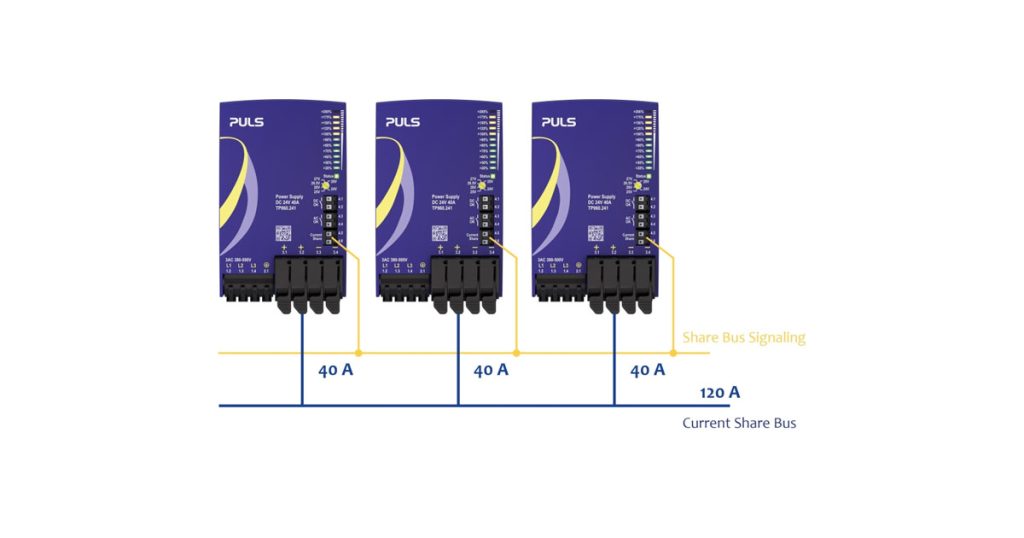
Conventional systems often rely on passive load sharing. This method can work, but its accuracy depends on closely matched output voltages, similar cable resistance and careful commissioning. Active load sharing takes a different approach. The connected power supplies communicate with each other via a Load Share Bus and regulate their current contribution continuously.
PULS uses this technology in the 960 W three-phase power supplies of the PLANET family. In the TP960, active load sharing is combined with up to 200 % peak power, a full-load efficiency of 97 % and a housing width of 79 mm.
Why does passive load sharing have limitations?
Traditional power supplies connected in parallel frequently use a droop characteristic. With this method, the output voltage is deliberately reduced as the output current increases. If all power supplies are configured identically, this voltage drop can help distribute the load.
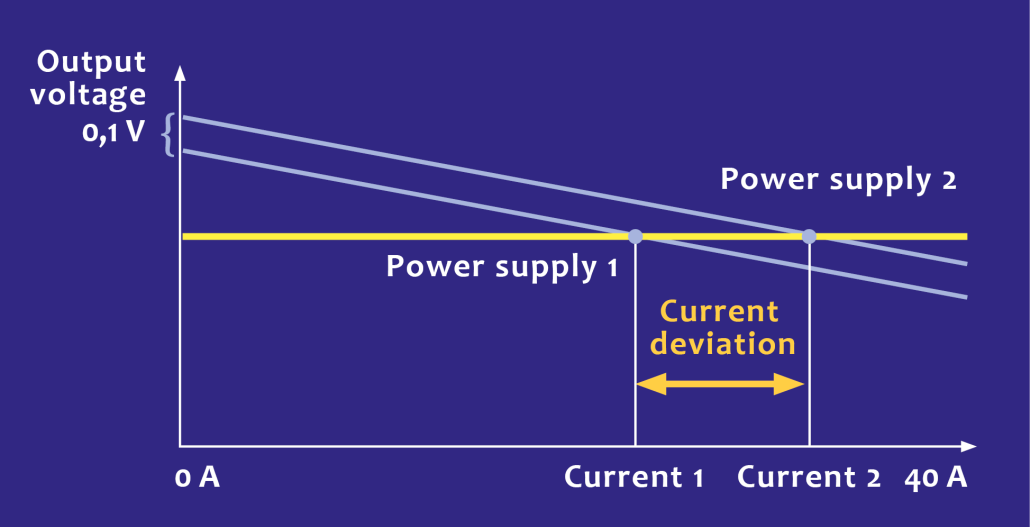
The main disadvantage is that the output voltage falls as the current increases. This is especially relevant in applications that require high short-term power while still depending on a stable supply voltage.
Passive load sharing also reacts strongly to small differences between the connected units. The output settings and cable resistance should be almost identical. In practice, however, component tolerances, different cable lengths, temperature drift and ageing can cause deviations.
Even a small voltage difference may lead to one power supply carrying more current than the others. The most heavily loaded device is then exposed to greater electrical and thermal stress. Over time, this can affect the reliability and service life of the complete system.
Commissioning also requires additional care. Depending on the design, users may need to activate a dedicated parallel mode, adjust the output voltages manually and use symmetrical wiring. Each step introduces additional time and a possible source of error.
How does active load sharing work?
Active load sharing distributes the current through a controlled communication process rather than through an intentional voltage drop.
The parallel-connected power supplies are linked by a single-wire load share bus. Each device continuously measures its output current and adjusts its contribution according to the total system load. This allows the connected units to share the required current evenly.
Because the current distribution is actively regulated, the output voltage can remain stable during both constant and dynamic loads. The system can also compensate for differences that would otherwise arise from tolerances, wiring, temperature changes or ageing.
In the PLANET TP960, the load share bus can compensate for voltage differences of up to 0.4 V. Communication takes place at a signal level of several volts, which makes the connection resistant to interference.
The result is a more predictable load distribution over the operating life of the system. Instead of one unit gradually taking on a larger share of the load, the connected power supplies continue to adjust their output currents.
When is active load sharing particularly useful?
The advantages are most visible in applications with high or rapidly changing power requirements.
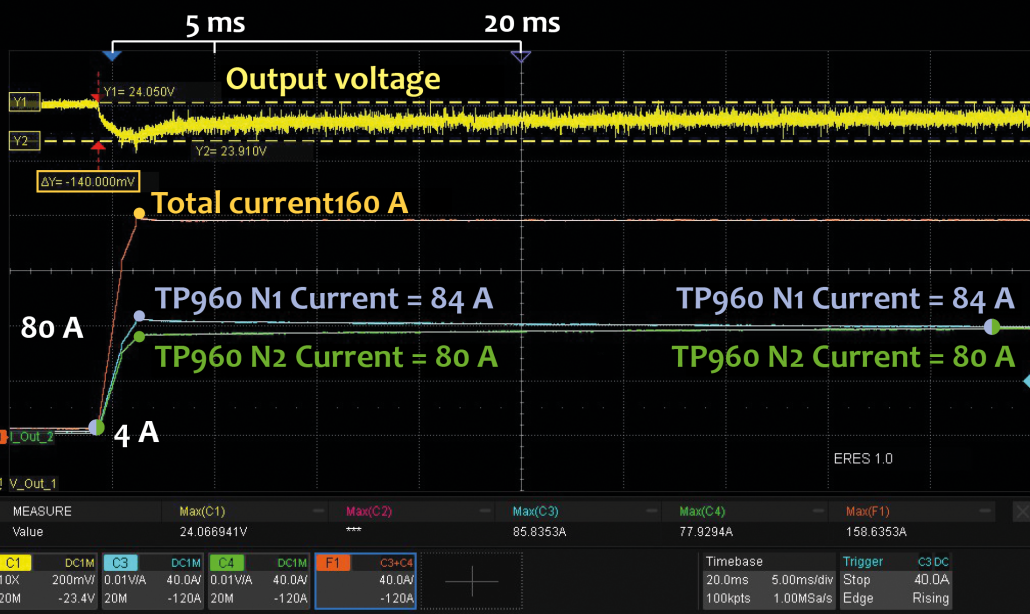
Motor starting is a typical example. During start-up, a motor may require considerably more power than during normal operation. At the same time, the supply voltage must remain stable to preserve the available torque.
The PLANET TP960 combines active load sharing with a peak power capability of up to 200 %. Two units connected in parallel can provide nearly 4 kW for several seconds while maintaining a stable output voltage.
The two power supplies require a combined installation width of 160 mm. This allows the power system to be sized for the normal operating load while still covering brief power peaks.
The same principle can be relevant for other dynamic industrial loads, including drives, actuators and automation systems with brief but substantial power peaks.
How does active load sharing simplify installation?
The advantages are not limited to electrical performance. Active load sharing can also reduce the effort required during installation and commissioning.
With the TP960, users do not need to match the output voltages manually using a multimeter. There is also no requirement for perfectly symmetrical wiring. The same output voltage is selected on each unit using the selector on the front of the power supply.
Quick-Connect spring-clamp terminals allow different conductor types to be connected without tools. The horizontal terminal arrangement on the underside of the unit keeps the front accessible after installation.
An integrated LED load indicator displays the current utilisation of each power supply. This makes it possible to check directly at the control cabinet whether the parallel-connected units are sharing the load evenly.
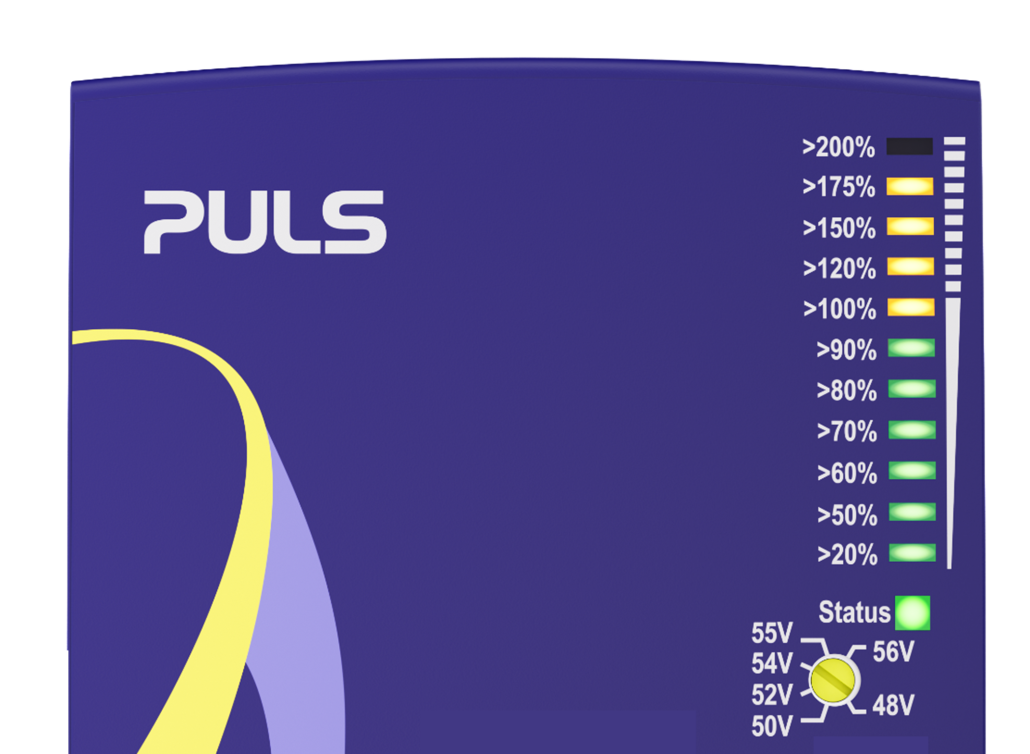
An additional status indication identifies overload or short-circuit conditions on the DC side. The combination of the load share bus, voltage selector, connection technology and LED load indicator can reduce installation time by up to 95 % compared with a passive load-sharing solution.
When should active load sharing replace passive load sharing?
Passive load sharing remains a workable approach in applications with moderate loads, limited dynamics and less demanding voltage requirements. Its main advantage is technical simplicity.
As power levels, peak loads and availability requirements increase, however, the disadvantages become more significant. Voltage droop, sensitivity to small deviations and additional commissioning effort can limit the performance of the complete system.
Active load sharing provides a controlled alternative. It maintains a more stable output voltage, distributes the current evenly and compensates for changes between the connected units over time.
For applications that require compact installation, dynamic peak power and reliable parallel operation, active load sharing offers a more precise way to combine multiple DIN rail power supplies.

https://www.pulspower.com/us/blog/active-load-sharing-for-din-rail-power-supplies/