Beyond the Hardware: Why AI Data Centers Need a Liquid-Cooling Strategy
As AI deployments drive rack densities beyond what conventional air cooling can efficiently support, more operators are introducing direct-to-chip liquid cooling, CDUs, and secondary coolant loops. But installing the equipment is only the first step. Long-term reliability also depends on how operators manage coolant health, monitor flow and temperature, detect leaks, maintain components, and coordinate the multiple vendors involved in a liquid-cooling system.
Liquid cooling ecosystem partnerships, like the Dow Coolant Care Network, offer a coordinated model that integrates fluid supply, testing, data analysis, expert interpretation, and mitigation support to reduce operational risk and maintain uptime.
To better understand the end-to-end service model designed to help data center operators confidently manage direct-to-chip liquid cooled systems, Panel Builder US recently interviewed Chuck Carn, the Global Growth Platform Leader for Data Centers in the Dow Industrial Solutions Business.
PBUS: What market challenges or customer feedback led to the development of the Dow Coolant Care Network, and why was now the right time to launch it?
Chuck Carn: The rapid expansion of data centers for AI and high-density computing has made cooling system reliability more critical than ever. Traditional air-cooling solutions are no longer sufficient to manage increasing heat loads, leading to the emergence of liquid cooling systems.
With the rise of direct-to-chip cooling, the importance of effectively managing cooling fluids has significantly increased. Fluid performance directly impacts system uptime, energy efficiency, equipment protection, and overall operational costs.
At the same time, fragmented testing methods, uncoordinated service providers, and unclear accountability are contributing to heightened operational risks. Liquid cooling system failures have proven to be costly. Customers have expressed a need for routine analysis, expert guidance, and actionable mitigation plans they can trust.
Dow recognized that customers were managing multiple vendors and processes without confidence that their needs were being fully addressed. This gap prompted the launch of a simpler, more integrated, and coordinated solution. Data Center owners can now hire service providers and confidently receive technical recommendations co-branded and supported by the technical experts behind DOWFROST™ Heat Transfer Fluid data center coolants.
PBUS: How does the Dow Coolant Care Network differ from traditional coolant supply or maintenance models used in data center liquid cooling systems?
Chuck Carn: Unlike traditional models where customers manage multiple vendors independently, the Dow Coolant Care Network integrates fluid supply, testing, data analysis, expert interpretation, and mitigation support into one coordinated model. Customers operate within a network of Dow-approved service providers and laboratories, ensuring standardized methods, validated data, and consistent reporting. Dow’s specialists review test data and provide actionable recommendations, streamlining the process and reducing operational risk. This approach simplifies the management of DOWFROST™ LC and DOWFROST™ HD Heat Transfer Fluids, helping reduce operational risk, improve consistency, and support cooling system reliability and uptime.
PBUS: Can you walk us through the core components of the Coolant Care Network—what services, monitoring capabilities, or support infrastructure are included?
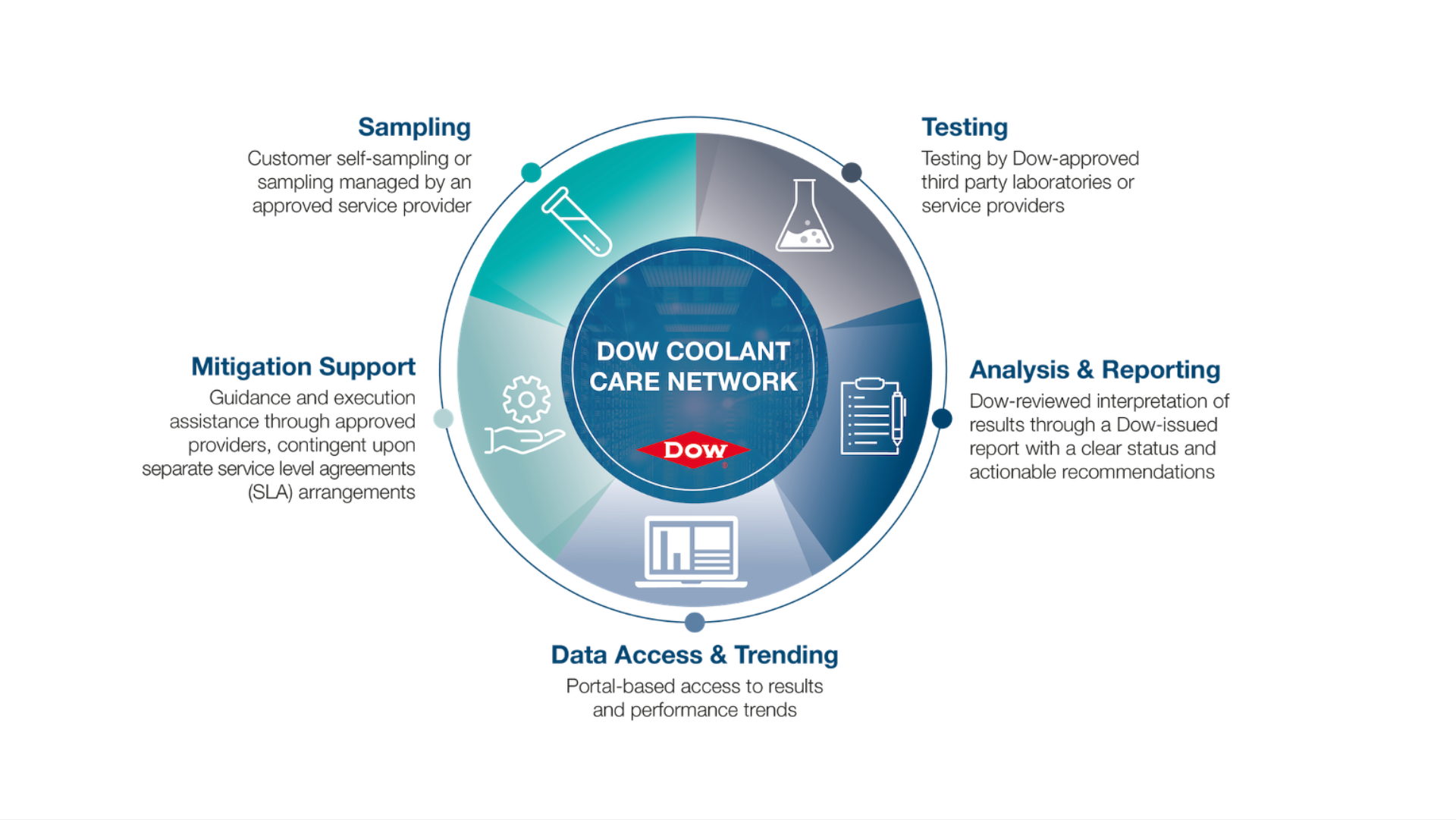
Chuck Carn: The network includes:
- Sampling (customer self-sampling or by approved providers)
- Testing (by Dow-approved labs or service providers)
- Analysis and reporting (Dow-reviewed interpretation and actionable recommendations)
- Mitigation support (guidance and execution via approved providers, with separate service level agreements)
- Data access and trending (portal-based access to results and performance trends)
PBUS: How does the network help data center operators ensure coolant quality over time, particularly in high-density AI and HPC environments?
Chuck Carn: The network provides routine, validated testing and Dow-reviewed analysis, enabling early issue detection and swift resolution. Operators receive clear, actionable guidance rather than just lab data, helping reduce risk and prevent downtime. The coordinated approach reduces the challenge of managing multiple vendors and supports ongoing reliability and uptime. Additionally, in a relatively new application, data center owners can trust recommendations from Dow researchers with decades of experience managing performance of similar chemistry in comparable applications. This brings simplicity to achieving uptime and reliable operations.
PBUS: What role does predictive maintenance or data analytics play within the Coolant Care Network, and how actionable are the insights for operators?
Chuck Carn: The network offers portal-based access to test results and performance trends, supporting data-driven insights. Dow’s analysis documents include technical interpretation and recommended actions, making the insights practical and easy to act on for system reliability and fluid health.
PBUS: For colocation providers and hyperscalers, how does this model impact total cost of ownership (TCO) and operational risk compared to in-house coolant management?
Chuck Carn: The pricing is transparent and competitive and is determined by fluid volume and loop type. The value extends beyond cost, encompassing reduced operational risks, enhanced systems reliability, and access to expert guidance.
A key differentiator is Dow’s deep expertise in DOWFROST™ Heat Transfer Fluid characteristics, performance, and required corrective actions. Dow provides critical technical guidance to help ensure optimal coolant performance, protect equipment and prevent issues before they impact operations. This level of expertise is especially valuable in data center environments, where performance demands are high and failure tolerance is minimal.
Compared to other applications, the need for reliable, specialized guidance and service in data centers is significantly higher due to the complexity and criticality of operations. By reducing operational complexity, improving decision-making, and ensuring consistent fluid management practices, the network can positively impact TCO and lower overall operational risk when compared to fragmented, in-house management.
PBUS: How is Dow addressing concerns around coolant lifecycle management, including degradation, contamination, and disposal or recycling?
Chuck Carn: Dow is addressing coolant lifecycle management by moving customers from reactive maintenance to proactive fluid-health stewardship. The Dow Coolant Care Network combines validated testing, expert interpretation, trend monitoring, and partner-enabled mitigation to help customers manage coolant degradation, contamination, corrective action, and disposal responsibly, supporting uptime, equipment protection, operational consistency, and long-term system reliability.
Dow also provides technical backing and training to fluid management providers who have strong backgrounds in either mechanical equipment or in water treatment, but who are new to the chemistry and implementation of DOWFROST™ Heat Transfer Fluids in this application. This ensures that whomever you choose to service your system upon commissioning is supported by the specialists at Dow with the most experience with the exact coolant formulation and operation.
PBUS: What level of integration is required between the Coolant Care Network and existing data center infrastructure, such as CDU systems, sensors, or DCIM platforms?
Chuck Carn: The Coolant Care Network does not need to be embedded into the data center’s control architecture to function. It can begin as a low-disruption fluid-health management service and evolve toward deeper digital integration where customers want enhanced monitoring, analytics, and predictive maintenance. This gives customers flexibility while allowing Dow to scale from lab-based care to more connected, data-enabled lifecycle management.
When the Data Center operations team needs to hire service providers for routine testing, commissioning or routine fluid maintenance, if they choose providers from the Dow Coolant Care Network, they can have confidence that those providers have a close relationship with Dow specialists and they have the best in class recommendations on how to monitor and optimize performance of their DOWFROST™ based cooling systems.
PBUS: How does the network support scalability for operators expanding liquid cooling deployments across multiple facilities or regions?
Chuck Carn: The network is designed for global scalability, with Dow-approved providers and laboratories worldwide. The coordinated model and standardized protocols ensure consistent service and support as operators expand across regions.
PBUS: Are there specific compliance, safety, or sustainability standards that the Coolant Care Network helps customers meet or exceed?
Chuck Carn: Many data center operations teams are relatively new to managing heat transfer fluids and other chemical products within cooling systems. As a result, they may face challenges related to safe handling practices, disposal requirements, and understanding applicable compliance obligations.
By working with testing, commissioning, fluid management, and disposal providers within the Dow Coolant Care Network, data center operators gain confidence that these activities are being managed safely, responsibly, and in alignment with industry best practices.
The Coolant Care Network helps customers strengthen EHS discipline, support proper coolant handling and disposal traceability, maintain audit-ready documentation, reduce environmental risk, and demonstrate responsible lifecycle stewardship of mission-critical cooling systems.
PBUS: Beyond coolant management, how is Dow innovating in materials science to support next-generation data center infrastructure, particularly in high-density and AI-driven environments?
Chuck Carn: Dow provides a broad portfolio of solutions that help improve the performance, reliability, and efficiency of critical data center infrastructure. Beyond primary and secondary loop coolants, Dow supports thermal management through its DOWSIL™ Thermal Management Solutions, which include advanced thermal interface materials (TIMs) designed to efficiently transfer heat from heat-generating components to heat removal systems. These materials are widely used in hyperscale data centers across applications such as optical transceivers, CPUs, GPUs, and other high-performance computing components that are critical to AI-driven workloads.
To support innovation and customer collaboration for heat management, Dow recently announced the Cooling Science Labs in Auburn, Michigan and Shanghai, our first collaborative R&D environments dedicated to thermal management, where customers can evaluate, test, and optimize materials for next-generation cooling challenges.
In addition, Dow provides a range of materials and technologies that enhance the performance, durability, and reliability of data center infrastructure and the building envelope. These solutions can help accelerate construction, improve long-term asset performance, and support evolving infrastructure requirements. For example, Dow offers solutions that can help address noise abatement needs, including BETAFOAM™ Acoustic Foams, which are 2K polyurethane foams for cavity filling and absorbing airborne and structure-borne noise, as well as ACOUSTICRYL™ Emulsion, an acrylic emulsion technology for acoustic insulation systems that helps reduce noise while supporting durability and processing ease. Dow also works directly with architects, engineers, and other stakeholders to provide material specifications and technical expertise during the design and development of data center facilities.
PBUS: Dow has a strong portfolio in thermal interface materials and advanced fluids. How are these technologies evolving to meet the demands of direct-to-chip and immersion cooling architectures?
Chuck Carn: Dow is advancing thermal management through a system-level approach to liquid cooling, helping enable the next generation of AI and high-performance computing infrastructure. Within direct-to-chip cooling architectures, Dow offers a broad portfolio of DOWSIL™ Thermal Interface Materials (TIMs) engineered to maximize heat transfer from high-power processors to liquid-cooled cold plates. As advanced package designs continue to push the limits of power density, transient loading, and package warpage, Dow is applying its deep materials science and formulation expertise to develop application-specific solutions that help maintain thermal performance and reliability under increasingly demanding operating conditions.
This same design philosophy extends beyond GPUs to other thermally critical components throughout the server ecosystem, including CPUs, high-bandwidth memory, optical transceivers, and power delivery modules. At the system level, DOWFROST™ LC Heat Transfer Fluid efficiently transports heat away from cold plates, supporting higher rack densities and enabling more effective thermal management of AI workloads.
In parallel, Dow is driving innovation in immersion cooling with DOWSIL™ Immersion Cooling Fluids, which are designed for full-server submersion. These advanced dielectric fluids deliver stable, high-performance thermal control while helping improve energy efficiency, operational safety, and overall data center sustainability. By supporting lower power usage effectiveness (PUE), immersion cooling can provide a scalable pathway for meeting future compute demands.
To accelerate technology adoption and system validation, Dow has established Cooling Science Studios in Shanghai, China, and Michigan, USA. These collaborative facilities enable customers to evaluate materials and cooling technologies at the system level, providing a platform for joint development, performance testing, and application-specific optimization.
Ultimately, the industry is moving toward tightly integrated cooling ecosystems in which thermal interface materials and cooling fluids are designed to work together as a complete thermal solution. Whether enabling direct-to-chip or immersion cooling architectures, Dow’s advanced materials portfolio helps customers optimize performance, reliability, and energy efficiency as they scale the next generation of AI and high-performance computing platforms.
PBUS: Can you discuss Dow’s role in improving reliability and longevity of data center hardware through materials such as sealants, adhesives, and encapsulants?
Chuck Carn: Dow materials help enhance the reliability, durability, and long-term performance of critical data center infrastructure by addressing potential failure modes across building, power, cooling, and electronic systems. As AI workloads drive higher power densities, greater thermal loads, and increased infrastructure complexity, the need for materials that can withstand demanding operating conditions becomes increasingly important.
Our sealants, binders, and adhesives product lines, such as MAINCOTE™ Emulsion, RHOPLEX™ Emulsion and DOWSIL™ Additive, support resilient buildings through durable weather sealing, air and moisture barrier performance, corrosion resistance, and long-term adhesion across substrates exposed to thermal cycling, humidity, vibration, and mechanical stress. In power conversion systems, control electronics, battery backup units, and liquid cooling hardware, Dow’s adhesive, gasket, and sealing technologies help protect assemblies from moisture ingress, particulate contamination, corrosion, and mechanical fatigue.
Dow encapsulants and potting materials further contribute to hardware protection by providing dielectric insulation, stress relief, environmental isolation, and protection against arcing, vibration, and contaminant exposure. In thermal management applications, Dow’s thermal interface materials support efficient heat transfer from high-power components while helping maintain low thermal resistance, processability, reworkability, and long-term reliability.
These materials also support liquid cooling reliability through fluid compatibility, corrosion protection, durable sealing of cold plates and manifolds, and long-term performance across a range of cooling loop designs. Together, Dow’s portfolio helps data center operators and equipment manufacturers improve system integrity, extend service life, reduce maintenance risk, and enable dependable operation as power density, thermal load, and infrastructure complexity continue to increase.
PBUS: Sustainability is a growing priority for operators. How is Dow contributing to reduced environmental impact across cooling, materials, and overall data center operations?
Chuck Carn: One of the most significant ways Dow contributes to addressing these concerns is through solutions that help reduce water usage. DOWFROST™ Heat Transfer Fluids enable closed-loop cooling system designs as an alternative to open-loop cooling systems, significantly reducing water consumption. These fluids also help provide stable, reliable system operation and can be maintained through routine testing and fluid management services. In addition, DOWFROST™ Heat Transfer Fluids can be supplied using certified and audited renewable raw materials and carbon-mitigated feedstocks.
Another major industry priority is reducing the environmental impact associated with the increased energy generation required to support the growth of data centers. Dow contributes through specialty amine technologies used in carbon capture processes, helping remove CO₂ from the combustion exhaust streams of combined-cycle natural gas power generation systems. The captured CO₂ can then be utilized or sequestered, supporting emissions reduction efforts.
Finally, noise is becoming an increasingly important consideration for data center developers, operators, and surrounding communities. Dow offers solutions that support noise abatement through materials specified for use in the building envelope, including acoustic insulation technologies that help reduce airborne and structure-borne noise. In addition, liquid cooling technologies can help reduce reliance on high-speed fans, replacing them with quieter pumping systems that circulate coolant more efficiently, thereby helping lower overall noise levels within and aound data center facilities.
PBUS: Looking ahead, what trends in data center design, such as higher rack densities, edge deployments, or modular builds, are shaping Dow’s R&D and product roadmap?
Chuck Carn: Rack density will continue to increase as demand for high-powered computing grows. Dow’s R&D efforts are focused on developing solutions that push the boundaries of single-phase liquid cooling capacity, as well as technologies that enable simple and effective monitoring, management, and mitigation of coolant-related issues. These innovations are intended to increase uptime and reduce the potential for IT equipment damage and downtime resulting from liquid cooling system failures.
In addition, Dow is focused on advancing thermal interface materials (TIMs) that reduce bond-line thickness while increasing the thermal performance of TIM 1.0, TIM 1.5, and TIM 2.0 applications. These developments help support the next generation of high-density computing architectures by improving heat transfer efficiency and enabling higher-performance thermal management solutions.
Key Links
More information about the Dow Coolant Care Network
More information about DOWFROST™ LC and DOWFROST™ HD Heat Transfer Fluids
About Chuck Carn

Chuck Carn is the Global Growth Platform Leader for Data Centers in the Dow Industrial solutions business. In this role he is responsible for business profitability, long term asset strategy, capital allocation and investment and business operations. He assumed this responsibility in 2018.
Chuck joined Dow in 2000 as an alternating term manufacturing co-op. In 2002, he became a technical sales representative in the Polyurethanes Systems House business and from 2003-2006 served as account manager for SARAN Products/Specialty Films/Food & Specialty Packaging based in Atlanta and later Chicago. In 2006, Chuck relocated to Midland as the NA Business Supply Chain planner for Engineering Thermoplastics and in late 2007 joined Specialty Packaging & Films (SP&F) as the Business Development manager where he was a member of the Business Management Team and led the Innovation Team for the business. In early 2010, Chuck was named a Global Strategic Marketing Manager in Polyglycols, Surfactants & Fluids and was responsible for the development and application expansion of products for the lubricant market. In 2011, Chuck was named North America Product director for Elastomers where he was responsible for optimizing the profitability of the North American Elastomers assets.
Chuck earned a B.S. in Chemical Engineering from Brigham Young University in 2001. He has five children and enjoys backpacking, playing the piano and coaching soccer.