GaN FETs Target the Next Generation of Electric Motor Drives
November 2, 2026
By Filippo Di Giovanni
Electric motors are getting smaller, smarter and more ubiquitous in products ranging from robots and automotive actuators to aircraft systems, medical equipment and cordless power tools. The growth is driven by the need for higher power density, better efficiency, more accurate torque control and smaller size. These trends are opening opportunities for gallium nitride (GaN) power transistors in low- and medium-power motor drives.
Industry forecasts point to continued growth in electric motors and electromechanical actuators, while semiconductor manufacturers are introducing GaN-based reference designs for brushless DC (BLDC) motors, servo drives, and robotics. The opportunity is not simply to replace an existing transistor. It is to improve the complete motor-drive system, from switching losses and current ripple to cooling requirements and mechanical integration.
Why GaN is attractive for motor control
Commercial GaN power FETs commonly use a high-electron-mobility transistor (HEMT) structure—in both enhancement- and depletion-mode variants—which supports fast switching, low gate charge and low output charge.
For motor drives, these characteristics can reduce switching losses and allow higher pulse-width modulation (PWM) frequencies. A higher switching frequency is beneficial in lowering harmonic distortion and limiting ripple, which leads to smoother torque and quieter motor operation. It can also reduce the size of input-filter components and, where appropriate, output filters.
Moreover, GaN devices do not have an intrinsic body diode like silicon MOSFETs. Reverse current can flow through the GaN channel, but its reverse-conduction voltage can be relatively high when the transistor is off. For this reason, dead-time management is important to minimize losses.
These benefits are particularly relevant to compact, low-voltage motor drives. In robotics, for example, power electronics may be integrated close to the motor inside mechanical limbs, leaving little room for heatsinks, bulky capacitors, or additional filtering. Reducing losses and component size can help engineers achieve greater torque capability within a constrained volume.
Where GaN Is finding opportunities
Robotics is a natural target. Humanoid robots use multiple motorized joints that must respond quickly and control torque accurately. Compact GaN inverters can help reduce the volume and thermal burden of the electronics installed near each motor. Similar requirements apply to industrial servo drives, automated guided vehicles, and warehouse robots.
Automotive applications provide another opportunity. Electric pumps, fans, compressors, steering systems, and other actuators increasingly require efficient, electronically controlled motors.
In unmanned aerial vehicles, drones, and aircraft auxiliary systems, mass minimization delivers critical system-level benefits. GaN power FETs significantly reduce the form factor of motor-drive electronics, while their tolerance to radiation makes them suitable for space applications.
Cordless power tools, e-bikes/e-scooters, medical robotics, and compact industrial machinery require. higher power density, and battery efficiency, that can be met with GaN.
GaN versus silicon MOSFETs
Silicon MOSFETs remain highly competitive, particularly in cost-sensitive, high-volume applications. Backed by a well-established manufacturing ecosystem, these products can be selected in a broad combination of dies, packages, gate drivers, and protection solutions.
GaN becomes attractive when its lower switching energy and fast transitions produce a measurable system advantage. The gain may be greater at higher switching frequencies, where switching losses become increasingly important. GaN’s significantly shorter dead times, enabled by faster switching, improve inverter performance at low motor speeds, or low modulation indices.
Dead time is a blanking interval between turning off one transistor and turning on the other device in the same inverter leg to avoid cross-conduction. Since inductive current cannot change instantaneously, it continues to flow through an alternative path, changing the phase voltage from the value imposed by the controller. This deviation causes a dead-time-induced voltage error over a PWM cycle, resulting in current distortion and torque ripple. By shrinking this error window, GaN devices deliver cleaner low-speed operation and better voltage utilization.
In general, GaN is not systematically more efficient at any operating point. A silicon MOSFET, for example, with low on-resistance may outperform a GaN device in a design with dominating conduction losses, particularly when switching frequency is modest.
GaN also requires careful layout and gate-drive design. Fast transitions can increase EMI, ringing, and voltage overshoot. Its limited gate-voltage swing and protection requirements must carefully be considered along with short-circuit and avalanche capability.
Motor technology evolution
The growing adoption of permanent-magnet synchronous motors (PMSMs) and BLDC motors is boosting demand for compact, efficient three-phase inverters.
Field-oriented control (FOC), advanced current sensing, and increasingly sophisticated control algorithms allow precise torque and speed regulation. These techniques do not require GaN, but they create new opportunities to exploit faster switching and improved current-waveform control.
Motor integration is a remarkable trend. Tightly integrating the inverter and motor reduces cabling and footprint, but at the same time generates localized thermal hot spots. Lower transistor losses alleviate this thermal stress, while higher PWM frequencies favor the use of smaller filters. However, the motor’s electrical properties, insulation, parasitic capacitances, and EMC determine overall benefits to a large extent.
Portable equipment introduce additional design constraints. Robotics, drones, and battery-operated tools must balance performance against battery capacity and operating time. Reducing drive losses can improve system efficiency, although the actual improvement in runtime depends on the motor, mechanical load, battery, and control strategy.
Motor drive evaluation boards
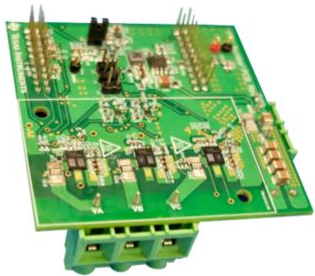
Several semiconductor manufacturers are demonstrating the potential of GaN in compact motor drives. TI’s TIDA-010936 reference design targets integrated servo drives and robotics, while ADI’s ADPS30146-RD supports GaN-based servo-drive applications from 50 W to 750 W. EPC’s EPC91118 is a three-phase BLDC motor-drive evaluation board designed for 15 V to 55 V input and switching frequencies of 80 kHz to 150 kHz. Together, these platforms illustrate the growing interest in GaN for space-constrained motor-control applications, including robotics, industrial automation, and compact electromechanical systems.
Picking the right semiconductor
GaN is best viewed as an additional option in the motor-drive designer’s toolkit. Silicon MOSFETs remain attractive where low cost, simplicity, and mature qualification are the main drivers.
GaN ranks first when compactness, switching performance, and reduced cooling requirements outweigh the additional design complexity. Silicon carbide (SiC) is preferred in higher-voltage and higher-power drives, although this technology can occasionally overlap GaN.
As new designs accommodate more compact and integrated motor drives, semiconductor selection will depend on system-level optimization. GaN will not replace silicon in every socket—rather, it provides the efficiency and density required for next-generation machines.